


Perhaps an unusual question, especially as the world relishes the potential of the incredible Airbus A321XLR. This article is not attempting to discredit the aircraft’s impeccable range nor its impressive overall economics. It is seen by many airlines as a viable replacement for the Boeing 757. More than that, it boasts a favorable cost base to the extent that routes that were previously unfathomable are now well and truly on the table.
Airlines and airports alike are excited about the aircraft’s abilities. As I had previously reported, Dusseldorf Airport believes the plane will revive its once expansive long-haul network. It is in talks with airlines about the possibility of A321XLR flights and is eager to resume flights to places like the US and Canada. While the benefits are countless, there are also routes that simply are not suited to the A321XLR.
Slot Constraints
Flights to destinations that are slot-constrained are unlikely to use the A321XLR as a general rule. Of course, as I’ll demonstrate below, there are always going to be exceptions. Perhaps better said is that routes connecting two major hubs, especially those with one or both slot-constrained airports, will not see the A321XLR prioritized.
The plane is ideal for so-called ‘long and thin’ routes. In other words, it is perfect for flights that are of a reasonably long distance with less demand, given the plane’s lower capacity. It makes little sense to use the plane on high-demand, long routes to/from slot-constrained airport.
Here is a fact-based summary of the story contents:
Perhaps an unusual question, especially as the world relishes the potential of the incredible Airbus A321XLR. This article is not attempting to discredit the aircraft’s impeccable range nor its impressive overall economics. It is seen by many airlines as a viable replacement for the Boeing 757. More than that, it boasts a favorable cost base to the extent that routes that were previously unfathomable are now well and truly on the table.
Airlines and airports alike are excited about the aircraft’s abilities. As I had previously reported, Dusseldorf Airport believes the plane will revive its once expansive long-haul network. It is in talks with airlines about the possibility of A321XLR flights and is eager to resume flights to places like the US and Canada. While the benefits are countless, there are also routes that simply are not suited to the A321XLR.
Slot Constraints
Flights to destinations that are slot-constrained are unlikely to use the A321XLR as a general rule. Of course, as I’ll demonstrate below, there are always going to be exceptions. Perhaps better said is that routes connecting two major hubs, especially those with one or both slot-constrained airports, will not see the A321XLR prioritized.
The plane is ideal for so-called ‘long and thin’ routes. In other words, it is perfect for flights that are of a reasonably long distance with less demand, given the plane’s lower capacity. It makes little sense to use the plane on high-demand, long routes to/from slot-constrained airports.
Indeed, airlines might use the plane for high-demand routes in general. Offering multiple frequencies, rather than a single (higher-capacity) widebody flight per day, is often better. In some cases, a more attractive schedule can allow an airline to charge higher fares as customers are more willing to pay for well-timed flights. More frequencies are a lot harder to achieve at slot-constrained airports like London Heathrow Airport, Amsterdam Schiphol Airport or Frankfurt Airport.
Gaining Transatlantic Market Share
Related is the difficulty in accruing market share with such a low-capacity jet. Firstly, if it comes to a route between two hubs, there’s likely to be plenty of pre-existing one-stop or nonstop competition. Take JetBlue’s London to New York-JFK routes with its A321neos (not XLRs). Unsurprisingly, this is a well-established route and one of the busiest international air corridors in the world.
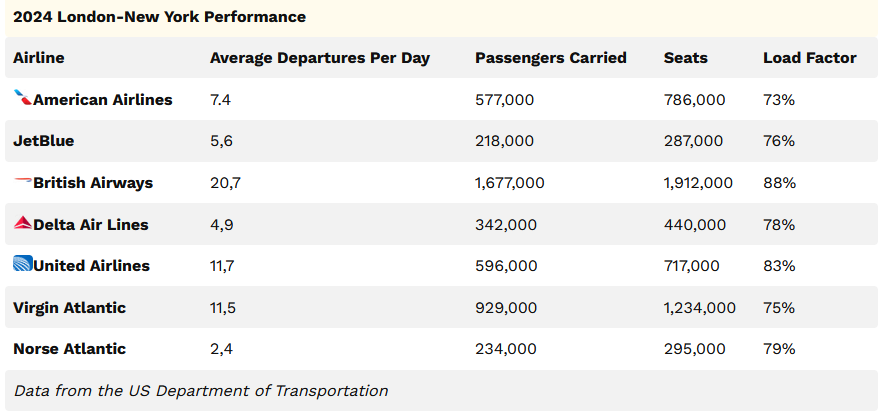
While it has managed to carve out a niche through cheaper flights and a quality product, it has struggled. Evidence for the fact that it isn’t easy to make such a route work is that it needed to suspend its routes between London Gatwick (LGW) and New York-JFK. This is not to say that the long-haul hub-to-hub A321 routes are unsuccessful; and JetBlue has little choice if it wants to stick to a cheaper, streamlined, and widebody-free fleet. Instead, this points to the fact that it is hard to gain market share which is a fact.
For network airlines like United Airlines, American Airlines, and Air Canada (all North American airlines with A321XLR orders), using a widebody on key trunk routes like those between their key hubs and London will most definitely be preferred. It would make little sense to switch out a widebody for the A321XLR on such routes as there is sufficient demand for a larger capacity jet, and limited slots.
Exceptions: Improving Performance

There are, of course, going to be exceptions to the above logic that an airline will judge on a case-by-case basis. Air Canada, for example, does want to fly the A321XLR to London Heathrow even if it is slot-constrained. In an exclusive interview with Simple Flying, the VP of Network Planning and Scheduling revealed that Ottawa to London was on the table for the aircraft type as one of its first routes.
Of course, Ottawa is not a major hub so it does not necessarily defy the above logic. It is a good route for the plane too, as even though it is presently operated by the Boeing 787, it is the kind of flight that could be switched out for a smaller plane at higher frequencies. The Airbus A321XLR will make the route more frequency-oriented. Whether Air Canada can find the slots for that at Heathrow is another question entirely.
All in all, the A321XLR provides countless opportunities for airlines and airports. Carriers will need to make sure that they use the plane wisely to take full advantage of its operational edge.
Credits: Airbus