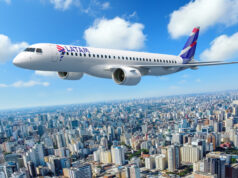

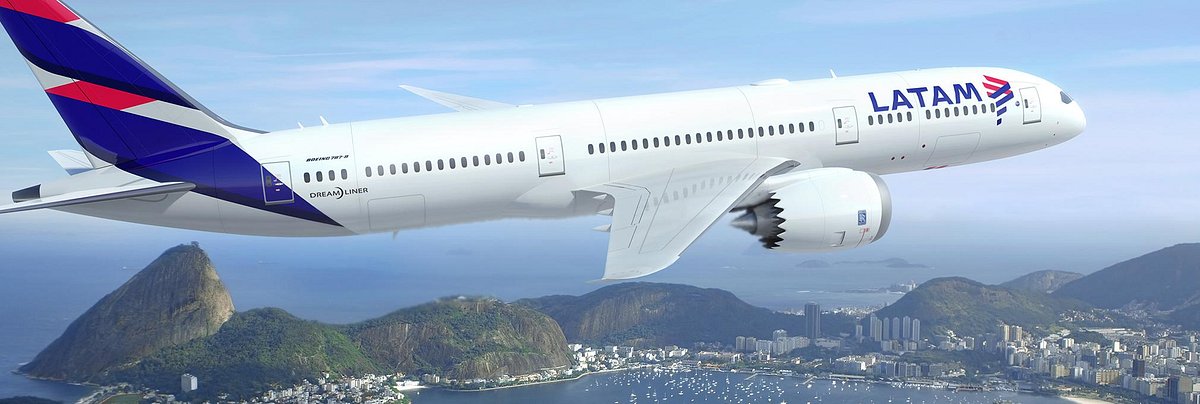
LATAM Airlines Group S.A. is a Chilean multinational airline holding company and the largest airline in Latin America, operating as a full-service carrier with scheduled passenger, cargo, and charter services. Headquartered in Santiago, Chile, it is a publicly traded company (ticker: LTM) with subsidiaries in Brazil, Chile, Colombia, Ecuador, Paraguay, and Peru. The group connects five domestic markets in South America and provides international services to North America, Europe, Oceania, and Africa, serving as a key gateway for regional and transcontinental travel. It is a member of oneworld alliance and emphasizes sustainability, targeting carbon neutrality by 2050 and zero waste to landfills by 2027. Key features include the LATAM Pass loyalty program (South America’s largest by membership) and partnerships like a joint venture with Delta Air Lines for enhanced North American connectivity.Key operational details include:
- Fleet: As of February 2025, 347 aircraft, including 56 Boeing wide-body passenger planes (767, 777, 787 models), 268 Airbus narrow-body planes (A319, A320, A320neo, A321, A321neo), 2 Airbus wide-body under short-term lease, and 21 cargo aircraft. The fleet grew 12% over the past two years with 30 new factory-direct additions since January 2023, and 12 more deliveries planned for Q2 2025, focusing on fuel-efficient models like A350s and 787s.
- Network: Serves over 146 destinations in 26 countries, with extensive domestic operations in Brazil, Chile, Colombia, Ecuador, and Peru. Key hubs include São Paulo–Guarulhos (GRU, Brazil), Arturo Merino Benítez (SCL, Chile), and Jorge Chávez (LIM, Peru). International routes span North America (e.g., Miami, New York), Europe (e.g., Madrid, Paris), Oceania (e.g., Sydney), and Africa (e.g., Johannesburg). It operates around 1,500 daily flights.
- Codes and Allowances: IATA code LA; ICAO code LAT. Baggage: Economy typically 1x23kg checked + 10kg carry-on (varies by route/class); Business 2x23kg checked + 16kg carry-on.
- Workforce and Performance: Employs over 39,000 staff. Trailing 12-month revenue of $13.2B as of June 2025; transported millions of passengers annually, with a 20% revenue growth forecast through 2025. It holds a leading market share in South America and focuses on AI-driven innovations for passenger experience.
LATAM positions itself as Latin America’s premier airline, prioritizing efficiency, connectivity, and sustainable growth amid regional challenges like currency fluctuations.
| Field | Details |
|---|---|
| Name | LATAM Airlines Group S.A. |
| Founded | 1929 (originally as LAN Chile) |
| Merger / Establishment of Current Brand | Merged LAN Airlines (Chile) with TAM Airlines (Brazil) in 2012; official adoption of LATAM brand in 2016 |
| Headquarters | Santiago, Chile |
| CEO | Roberto Alvo Milosawlewitsch |
| Primary Markets | Strong presence in five South American domestic markets: Chile, Brazil, Peru, Colombia, Ecuador; also international flights across Latin America, to Europe, the U.S., Caribbean, and Oceania |
| Fleet Composition | Mix of Boeing and Airbus models; operates aircraft like Boeing 767, 777, 787; Airbus A319, A320, A320neo, A321 among others |
| Destinations / Network | As of recent years, serves 150+ destinations in around 27 countries |
| Employees | ~35,000‑40,000+ (varies with reporting period) |
| Stock / Ownership | Public company; shares listed on Santiago Stock Exchange; formerly had ADRs on NYSE (some changes after financial restructuring) |
| Sustainability / Environmental Strategy | Has programs to reduce single‑use plastics; goal for carbon neutrality by 2050; part of sustainability indices (e.g., Dow Jones Sustainability Index) |
Brief History
LATAM Airlines Group’s roots trace to 1929 with the founding of Línea Aeropostal Santiago-Arica (Lansa) in Chile, which evolved into LAN-Chile in 1945 as the national flag carrier. LAN expanded internationally in the 1950s–1980s, incorporating aircraft like Boeing 707s and 767s, and establishing subsidiaries in Argentina, Peru, and Ecuador. Privatization in 1989 spurred growth, with fleet modernization to Airbus A320 family in the 2000s, retiring Boeing 737s by 2008.
In Brazil, TAM Linhas Aéreas began as Táxi Aéreo Marília in 1961, growing through acquisitions like LAPSA (1975) and Pantanal (2009), and joining Star Alliance in 2009 with Boeing 777 introductions. A non-binding merger agreement between LAN and TAM was signed on August 13, 2010, followed by binding terms on January 19, 2011, and completion on June 22, 2012, creating LATAM Airlines Group under CEO Enrique Cueto. The merger faced regulatory hurdles, including slot transfers at São Paulo and alliance choice requirements (joined oneworld in 2014).
The 2010s brought expansions: Qatar Airways acquired 10% stake in 2016; new logo unveiled in 2015. Challenges included A320neo and 787 groundings in 2018 due to engine issues. COVID-19 prompted Chapter 11 bankruptcy filing in May 2020; emergence in June 2022 with debt restructuring and Delta’s 15% stake. Recovery accelerated with fleet additions and Wi-Fi rollout (100% on Brazilian narrow-bodies by 2025).
By 2025, LATAM reported robust growth, with 12 new aircraft deliveries in Q2, enhanced sustainability initiatives, and leadership in South American aviation, connecting over 150 destinations while navigating fuel costs and geopolitical risks.
| Year / Period | Milestone / Event |
|---|---|
| 1929 | LAN founded as Línea Aéropostal Santiago‑Arica (LAN Chile) |
| 1960s‑2000s | LAN expands, forms subsidiaries in Peru, Colombia, Ecuador; acquires other Chilean carriers; TAM grows in Brazil |
| 2010 | LAN and TAM announce a non‑binding agreement to merge |
| 2012 | Merger completed; LATAM Airlines Group officially formed by combining LAN and TAM operations |
| 2016 | The LATAM brand fully adopted; unified livery and brand identity across member airlines |
| 2019 | Delta Air Lines reaches agreement to acquire a 20% stake in LATAM; LATAM later leaves the Oneworld alliance |
| 2020 | Due to the impact of COVID‑19, LATAM enters Chapter 11 (U.S.) for financial reorganization |
| 2021‑2022 | Emerges from Chapter 11; approves restructuring plans; launches sustainability strategy with targets (e.g. plastic use reduction, emission goals) |
| 2023‑2025 | Continued focus on recovering operations; emphasis on fleet modernization; strengthening market share in Brazil; expanding joint ventures and international partnerships; enhancing passenger experience and environmental performance |