
Why Did Aegean Airlines Cancel Its Order?
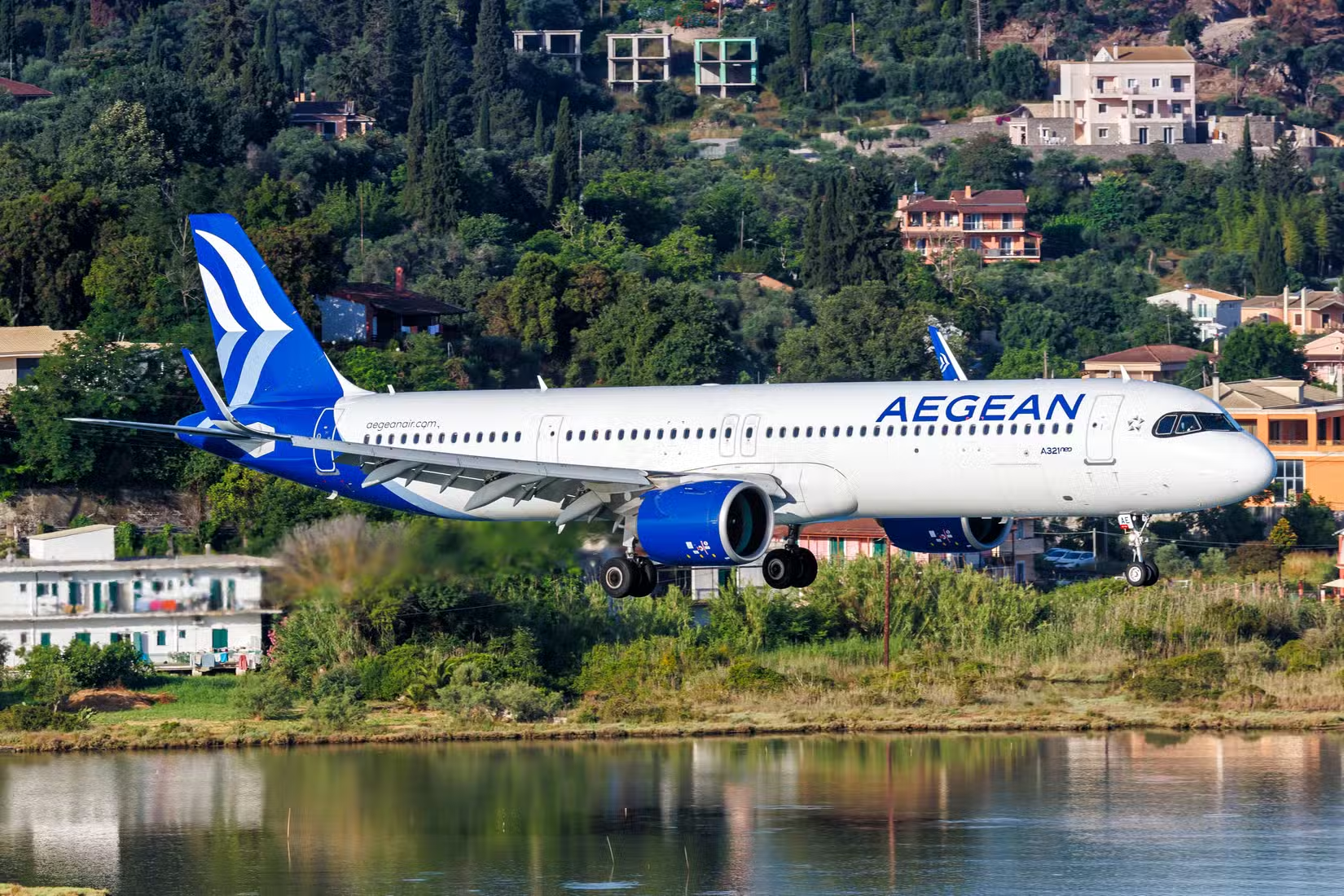
The core reason for the cancellation of this order was timing. Aegean Airlines chairman Eftichio Vassilakis said that the pair of A321XLRs, which were sourced from another airline that no longer wanted them, ran into certification issues involving the seats. That pushed delivery of the type back by roughly seven to eight months, meaning that the jets would only arrive by late summer or autumn, positioning the aircraft poorly to serve the peak summer season that it believes is critical for these routes’ profitability.
This means that, for the airline, this delivery timeline shift makes the jets much less strategically useful, all because the aircraft were intended to accelerate entry into longer-distance markets, especially India, ahead of the 2026 summer season. Instead of taking on two delayed A321XLR models, the airline chose to cancel these orders, keep total neo-family commitments at 60, and look toward a more standardized six-aircraft A321LR fleet instead.
Aegean Airlines Had A Good Reason To Order The A321XLR
The original logic behind the airline’s A321XLR deal was both ambitious and rational. Aegean Airlines had already committed to four A321LRs as part of a wider strategy to push beyond its traditional European and near-regional footprint. Starting in 2025, the airline made the headlines when it announced it would be adding a pair of XLRs to the mix.
this took the airline’s total commitments to the family up to 60, making it one of the largest customers for the type in Europe. Those XLRs were marketed as a premium-heavy tool that was going to serve a special purpose. They are equipped with just 138 seats, including 24 lie-flat business-class suites, alongside upgraded in-flight entertainment, Wi-Fi, and a cabin tailored for flights well beyond the airline’s normal network, according to FlightGlobal.
They were supposed to let Aegean start flying from Athens to New Delhi in March 2026 and from Athens to Mumbai in May 2026, while the later-arriving A321LRs would support broader expansion to regional markets. Thus, these A321XLRs were meant to fast-forward Aegean’s long-range growth story by roughly a year.
What Does This Mean For Airbus And Aegean?
When it comes to Aegean, this is a delay rather than a retreat from the overall strategy itself. The airline still wants a six-aircraft long-range narrowbody subfleet, but that now appears to lean in favor of a cleaner all-LR structure rather than mixing the two types. This is unsurprisingly the kind of simplicity that shareholders will probably prefer.
The airline’s leaders have explicitly discussed the benefits of having a homogenous subfleet, even if the trade-off is pushing India back by around a year. For Airbus, however, the headline is somewhat awkward as the A321XLR loses a visible European operator just as the type is becoming a flagship narrowbody product on the continent.
The commercial damage, however, appears somewhat limited. Aegean is not breaking with Airbus, and it has sourced a pair of A321neos in order to keep its overall commitments at 60. The airline had already expanded its Airbus orderbook significantly in 2025. This is less of a visible vote against the XLR as a concept and more a case where delivery timing and fleet complexity overrode an otherwise compelling aircraft plan.
Credits: Europe Airline