
Airbus is one of the leading manufacturers, and over the years, it has built some of the most successful commercial aircraft in the world that form the backbone of many airline fleets today. For decades, the company has competed head-to-head with Boeing in the passenger aircraft market, but cargo tells a different story. The US manufacturers’ freighters, especially the 747 and 777, dominate the sector. That said, Airbus tried to address this with models such as the A300, A310, and later the A330-200F, but none shifted the balance.
Today, its freighters account for less than 10% of the dedicated global cargo fleet. But now, the European planemaker intends to change that dynamic with the Airbus A350F, a purpose-built widebody freighter based on its A350-1000 platform. The manufacturer says it will be the first aircraft to meet ICAO’s 2027 carbon emission standards and is expected to deliver up to 40% lower fuel burn and emissions than its rivals.
Airbus Has Received More Than 60 Orders For The A350F
Several major cargo operators see the A350F as an aircraft that could reshape the freighter market in the years ahead. As per ch-aviation data, Airbus has secured close to 68 orders for the type so far. However, it is worth noting that the planemaker has seen some adjustments to its order book this year (which we will discuss later in the article). The program was developed in response to growing demand for new freighters.
According to IATA, global air cargo demand is expected to increase in the coming years. The organization forecasted demand to grow by about 5.8% this year, though due to the trade war, the figure has been lowered to 4.8%. In addition, industry forecasts suggest that by 2044, airlines will require around 4,000 new freighters. Airbus saw this as an opportunity to develop a next-generation aircraft that could replace aging fleets while offering the efficiency operators expect in today’s market.
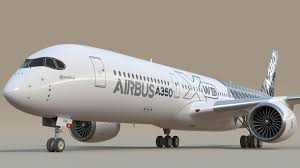
In July 2021, during the Dubai Airshow, it formally launched the A350F. As previously mentioned, the aircraft is based on the A350-1000, the largest member of the A350 family. Since entering service, the family has become the backbone of long-haul operations for many carriers worldwide. The freighter adapts the same proven design for cargo operations and will combine the family’s efficiency with dedicated freight features, including the extra-large cargo door.
Spirit AeroSystems And The Supply Chain Struggles Are Slowing The Program
However, the program has faced repeated delays, and the aircraft remains uncertified. Airbus had initially planned to introduce the A350F in 2025, but later moved the target to 2026. Earlier this year, the company confirmed a further slip; it is now projecting entry into service in the second half of 2027. The main reason for the delay is supply chain issues, most notably with Spirit AeroSystems, which produces the central fuselage section of the A350.
The company is currently undergoing a major restructuring, which has impacted its operations and slowed output for the A350 program. This follows Boeing’s decision last year to reacquire the supplier, which has also created uncertainty for Airbus. However, to secure its own programs, the European planemaker struck a parallel deal to acquire Spirit’s Airbus-related operations. In April this year, it formalized a $439 million divestiture agreement.
The deal covers the acquisition of A350 fuselage sites in Kinston, North Carolina, and St. Nazaire, France, as well as A321 and A220 production in Casablanca, Morocco; A220 pylons in Wichita, Kansas; and A220 wing and mid-fuselage production in Belfast, Northern Ireland. Airbus will also take over the Prestwick, Scotland, site that manufactures wing components for the A320 and A350.
The acquisition was originally expected to be completed in the third quarter of 2025 but has slipped to the fourth quarter because of delays in regulatory approval. The manufacturer said that the move will “ensure stability of supply for its commercial aircraft programs through a more sustainable way forward, both operationally and financially, for key Airbus work packages.”
Visible Progress, But Delays Cost Airbus Key Orders
Hopefully, Airbus will stabilize its supply chain and get the A350F program back on track. Notably, there has been some progress in recent months. Earlier in June, the company finalized the wingset for the first aircraft at its Broughton facility and shipped it to Toulouse. In late July, it completed the first horizontal stabilizer in Spain. Additionally, just last month, Airbus confirmed to the STAT Trade Times that the central fuselage for the first test aircraft arrived in Toulouse on the 19th, followed by the forward fuselage on the 21st.
With these sections now on site, final assembly seems to be underway. The manufacturer plans to build two test aircraft; flight testing is set for 2026, with certification expected in late 2026 or early 2027. However, the drawn-out timeline has already cost some orders. Air Lease Corporation, which was originally the launch customer with seven aircraft on order, has canceled its entire commitment, citing the aircraft production delays and uncertainty in the cargo market.
In addition, last month, Air France-KLM Group confirmed it will reduce its commitment to six aircraft. The group had initially ordered eight, split evenly between Air France and its Dutch subsidiary Martinair. But, after a fleet strategy review, the total was reduced to three aircraft per carrier.
The group said the decision reflected Airbus’ revised entry-into-service timeline and the need to balance capital expenditure with operational efficiency. The A350Fs had been intended to replace Air France Cargo’s two Boeing 777 freighters and Martinair’s four 747-400Fs, though those older aircraft may now remain in service longer than expected.
Which Airlines Are Still Backing The A350F?
Even so, several airlines are still putting their faith in the A350F. As previously noted, Airbus’ order book stands at about 68 aircraft, with both Etihad Airways and STARLUX having placed the largest commitments to date with ten aircraft each. The Abu Dhabi-based airline first signed for seven aircraft at the 2022 Singapore Airshow, then added three more in 2024 as it looked to expand its freight operations. These jets will join its current freighter fleet of five Boeing 777-200Fs, which, according to ch-aviation data, were delivered between 2013 and 2018.
Meanwhile, Taiwan’s STARLUX initially ordered five and added another five earlier this year. The carrier has said it intends to operate the A350F on some of the busiest cargo corridors. At the time of the order, Glenn Chai, CEO of STARLUX, said, “The A350F is the perfect choice for STARLUX, offering a similar payload-range capability as previous generation freighters, but with very significant reductions in fuel consumption and carbon emissions.”
Furthermore, several other operators have also backed the A350F program. The cargo giant CMA CGM Air Cargo has placed an order for eight and will be the launch operator of the type. In addition, Cathay Pacific has six on order, Singapore Airlines seven, Silk Way West two, and Turkish Airlines five. The planemaker has also received interest from lessors and secured an order for ten aircraft from Saudi Arabia’s AviLease in July and two from MNG Airlines during the Paris Air Show in June.
What The A350F Would Offer Compared To Existing Freighters
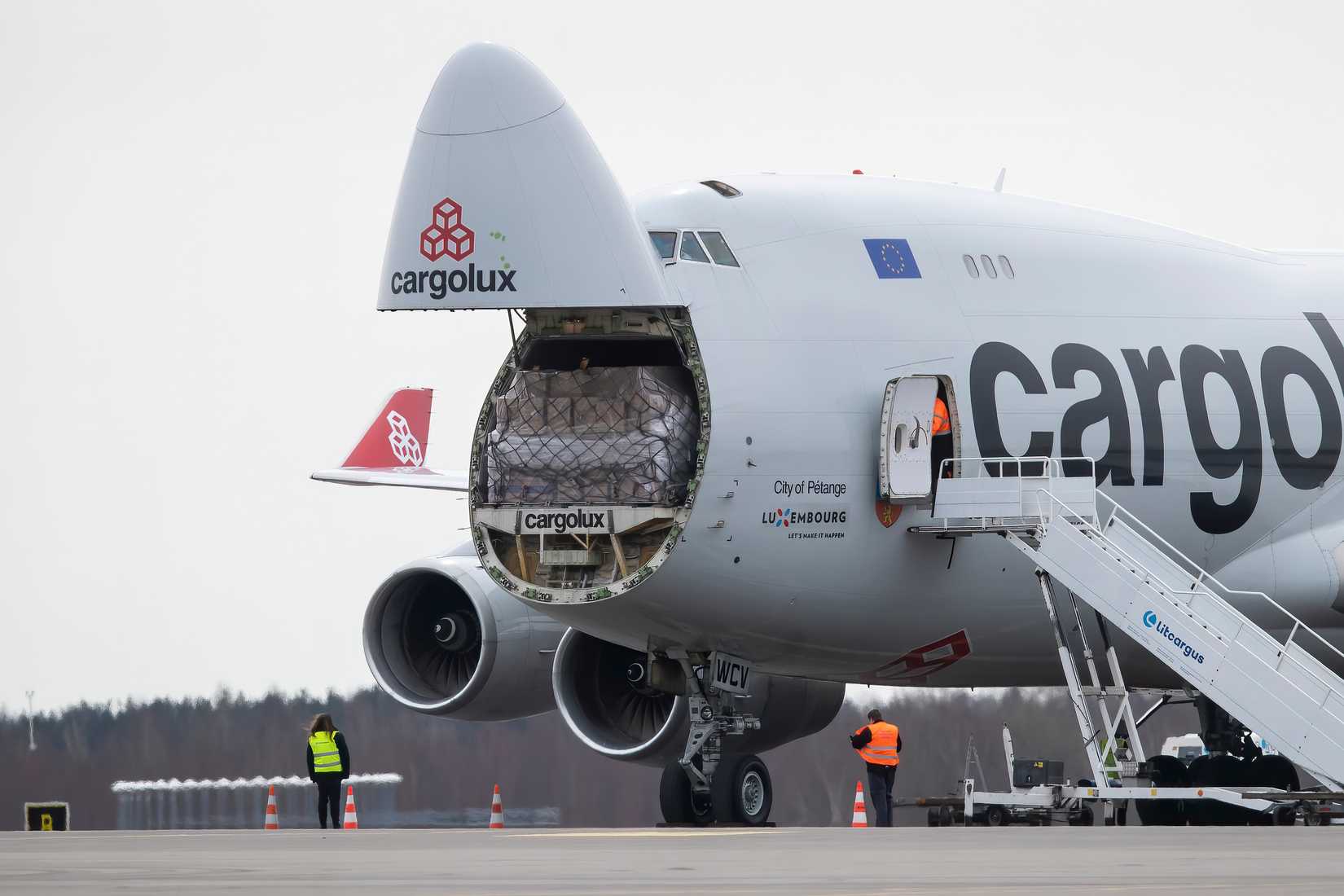
Indeed, part of the appeal of the A350F comes from what it would offer compared with existing freighters. Similar to the rest of the A350 family, more than half of the freighter’s structure, including the fuselage, wings, and tail, is made from composites, which improves efficiency. According to Airbus, the aircraft will deliver around 20% less fuel burn and lower carbon emissions compared to the Boeing 777F, and about 40% lower compared to the 747-400F.
Furthermore, compared to the 777F, the A350F offers 11% more cargo volume, equal to about three and a half additional main-deck pallets. It is designed for a maximum structural payload of roughly 111 tonnes. In its general cargo layout, the manufacturer lists space for 30 pallets measuring 96 x 125 inches on the main deck and 12 more on the lower deck. In an express layout, it can carry 30 AM-based containers on the main deck and 40 LD3 containers on the lower deck.
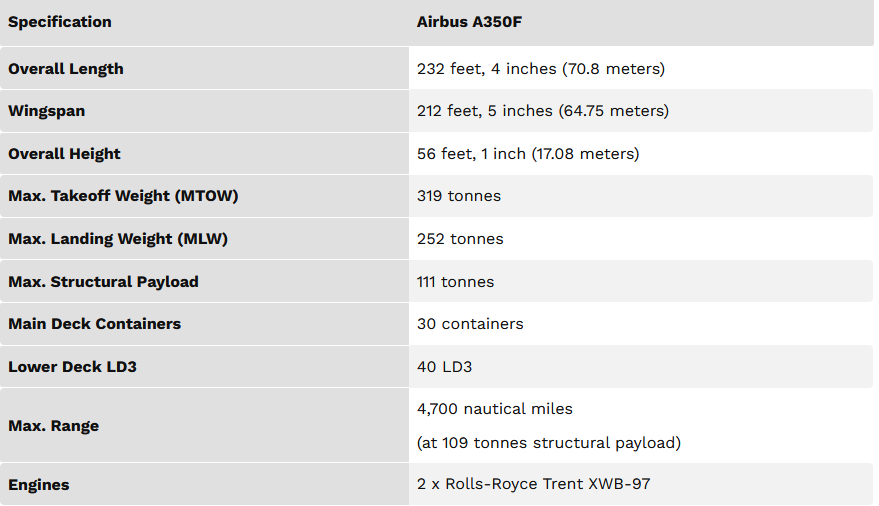
Against the 747-400F, the new Airbus freighter matches payload capacity but with up to 40% lower operating cost per tonne per trip, according to the European planemaker. That being said, looking ahead, it will not enter an empty market. Boeing is also advancing its 777-8F, which is based on the latest 777X platform.
The aircraft is set to become the largest twin-engine freighter in service and is expected to carry a greater payload than the current 777F while improving fuel efficiency and range. The US planemaker has already secured 59 firm orders for the type, including 34 from launch customer Qatar Airways, ten from Cargolux, seven from Lufthansa, four from China Airlines, and two each from ANA and Silk Way West.
Can Airbus Finally Gain A Foothold In The Freighter Market?
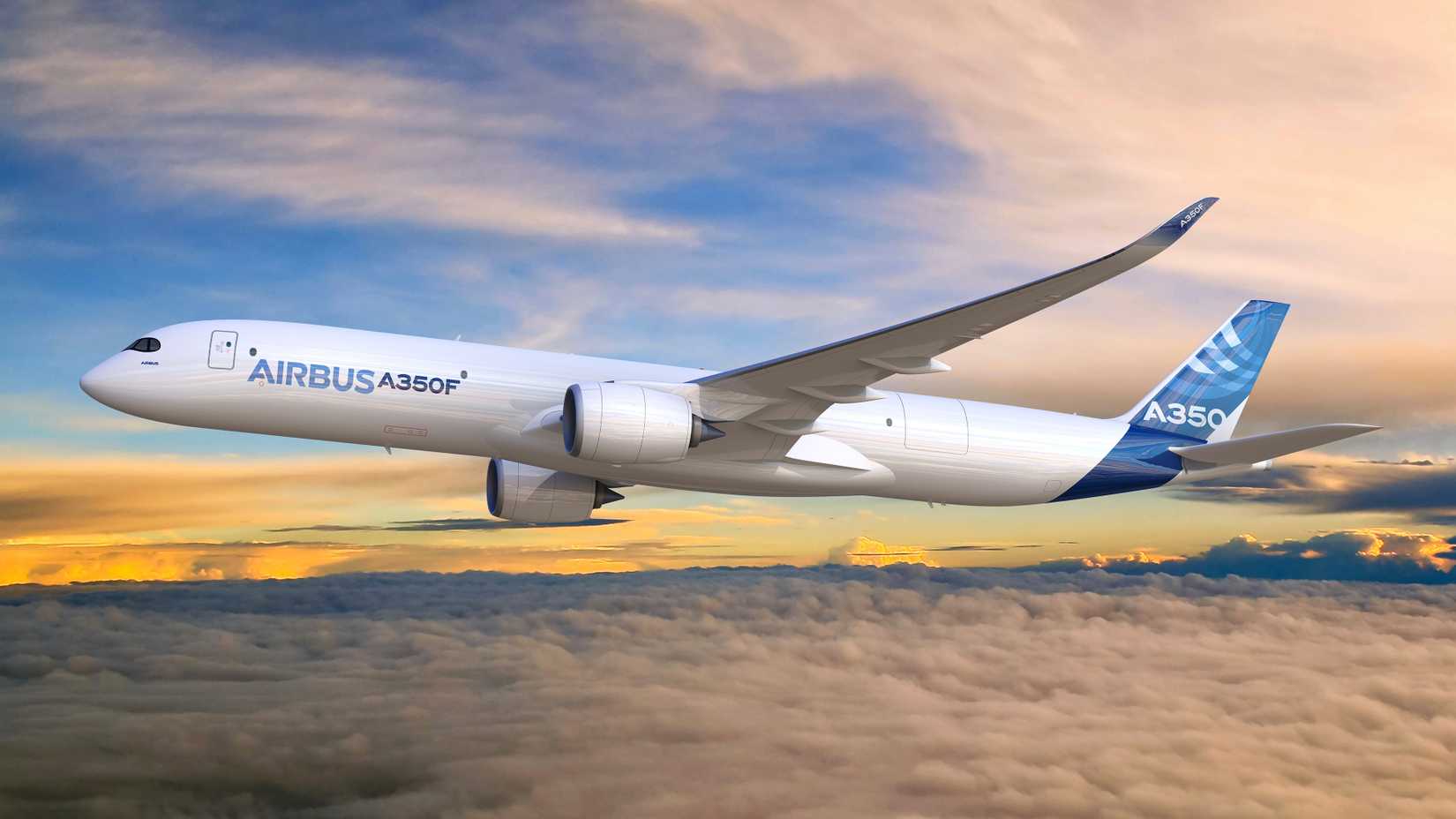
Indeed, over the next few years, the freighter market is set to enter a new phase with both Airbus and Boeing introducing next-generation aircraft. For Airbus, the A350F represents a chance to establish a stronger foothold in a segment it has long struggled to compete in, while for operators it offers an efficient alternative as aging fleets face replacement and environmental regulations become more stringent.
Several major operators have already placed their bets on the aircraft, but progress has not been without setbacks. The program has been slowed by supply chain issues, resulting in delays and some order cancellations. But, Airbus has moved to stabilize its production network, including the acquisition of key Spirit AeroSystems facilities, to secure a steady flow of components for the A350F and its other programs.
How quickly the manufacturer delivers on these commitments will be a key consideration now. If it can keep its order book intact and bring the freighter to market on schedule, the A350F could give it a meaningful share of a segment that has long been dominated by Boeing.