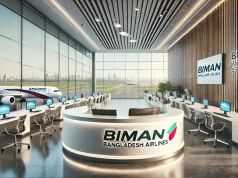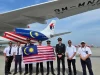

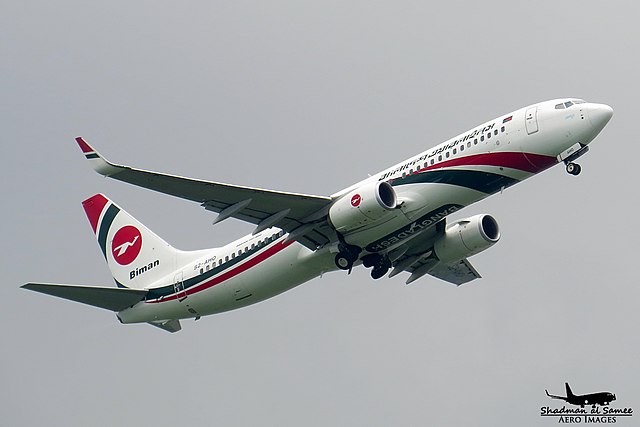
Biman Bangladesh Airlines (commonly known as Biman) is the national flag carrier of Bangladesh, operating as a full-service airline with scheduled passenger, cargo, and charter flights. Headquartered in Dhaka at Balaka, it is wholly owned by the Government of Bangladesh and structured as the country’s largest public limited company since 2007, governed by a board of directors appointed by the government and led by a Managing Director & CEO. As an IATA member, Biman emphasizes its role as a brand ambassador for Bangladesh, with a tail insignia reflecting national pride. It provides ancillary services through subsidiaries, including ground handling (Biman Ground Handling), flight catering (Biman Flight Catering Centre), aviation training (Bangladesh Airlines Training Centre, EASA Part-147 approved), engineering (Biman Engineering), and even poultry farming (Biman Poultry Complex). The airline handles annual Hajj operations, transporting pilgrims, tourists, migrants, and expatriate workers, and supports cargo connectivity via partnerships like My Freighter in 2025.Key operational details include:
- Fleet: As of July 2025, 21 aircraft comprising 4 Boeing 737-800s, 4 Boeing 777-300ERs, 4 Boeing 787-8s, 2 Boeing 787-9s, and 5 De Havilland Canada Dash 8-400s (Q400s). No active orders for additional aircraft are noted, following a modernization drive that phased out older models like DC-10s and Airbus A310s.
- Network: Serves 30 destinations across 48 routes, including 22 international (e.g., Abu Dhabi, Bangkok, Delhi, Doha, Dubai, Guangzhou, Jeddah, Kathmandu, Kolkata, Kuala Lumpur, Kuwait, London-Gatwick, Manchester, Medina, Muscat, Riyadh, Sharjah, Singapore, Toronto-Pearson) and 8 domestic (Dhaka, Chittagong, Sylhet, Jessore, Rajshahi, Saidpur, Cox’s Bazar). Main hub: Hazrat Shahjalal International Airport (DAC), Dhaka; secondary hubs: Shah Amanat International Airport (CGP), Chittagong; Osmani International Airport (ZYL), Sylhet.
- Codes and Allowances: IATA code BG; ICAO code BBG. Baggage: 20 kg checked (domestic/international); 7 kg cabin (max 56x36x23 cm).
- Workforce and Performance: Employs thousands, with a focus on skilled manpower training. Reported profits for three consecutive years by 2017, though it has faced historical challenges like overstaffing and losses. In 2025, it continues fleet optimization and tech upgrades, including SITA systems since 2013.
Biman positions itself as a key connector for Bangladesh’s growing economy, prioritizing safety, reliability, and cultural representation.
| Field | Details |
|---|---|
| Name | Biman Bangladesh Airlines Ltd. |
| Founded | 4 January 1972 |
| Legal Status | Fully state-owned; converted into a public limited company in 2007 |
| Headquarters | Balaka Bhaban, Kurmitola, Dhaka-1229, Bangladesh |
| Main Hub | Hazrat Shahjalal International Airport, Dhaka |
| Secondary Hubs | Shah Amanat International Airport (Chittagong), Osmani International Airport (Sylhet) |
| Fleet Size / Composition | Around 21 aircraft, including Boeing 777-300ER, Boeing 787-8 and 787-9 Dreamliner, Boeing 737-800, and De Havilland Dash-8 Q400 |
| Destinations | 7 domestic and approximately 16 international destinations |
| Codeshare / Agreements | Has air service agreements and codeshare partnerships with multiple countries |
| Certifications / Safety | IOSA (IATA Operational Safety Audit) certified; ISAGO certified for ground handling |
| Fleet Modernization Plans | Plans to purchase 26 new aircraft by 2034, including Airbus A350 (passenger and cargo variants) |
Brief History
Biman Bangladesh Airlines was born amid Bangladesh’s independence in 1971, when 2,500 former Pakistan International Airlines employees proposed forming a national carrier. Established on 4 January 1972 via Presidential Order No. 126 as Air Bangladesh (renamed Biman shortly after), it began domestic operations on 4 February with a Douglas DC-3, linking Dhaka to Chittagong, Jessore, and Sylhet—despite starting with no aircraft of its own. International services launched on 4 March with a chartered Boeing 707 to London, marking the start of its monopoly in Bangladesh’s aviation until 1996.
The 1970s and 1980s saw rapid expansion: Fleet additions included Fokker F27s (1972), more Boeing 707s (1973–1979), DC-10s (1983), and Fokker F28s (1981). Routes grew to 29 international destinations by the 1980s, from New York to Tokyo, including key Middle Eastern (Jeddah, 1978) and Asian (Bangkok, 1974; Singapore, 1977) hubs. It achieved profitability in 1978–79 and became a public sector corporation in 1977 with limited autonomy; share capital rose to BDT 2 billion in 1987. Challenges included accidents, like the 1984 Fokker F27 crash near Dhaka killing 49.
The 1990s brought Airbus A310s (1996–2003) and domestic ATPs (1990), but corruption, overstaffing, and political interference led to audits revealing debts (e.g., BDT 2.2 million in 1999). Market liberalization in 1996 ended its monopoly, prompting restructuring. The 2000s focused on recovery: Transformed into a public limited company on 23 July 2007 with government retaining full ownership (plans for 49% private stake unfulfilled), a Voluntary Retirement Scheme reduced staff, and Boeing deals in 2008 secured 737-800s, 777-300ERs, and 787-8s. The first 777 arrived in 2011, and DC-10s were phased out by 2014.
Modernization accelerated in the 2010s: New livery in 2010; first 787-8 in 2018; additional Dreamliners in 2019. Incidents included a 2019 hijacking attempt and Yangon crash. COVID-19 disruptions led to route adjustments, but recovery included Dhaka-Toronto launches in 2022 (with technical stops). By 2025, Biman has stabilized operations, added Dash 8s for domestic routes, and enhanced cargo/tech partnerships, solidifying its role in Bangladesh’s aviation sector despite past hurdles.
| Year / Period | Milestone / Event |
|---|---|
| 1971–1972 | Following Bangladesh’s independence, former aviation professionals proposed a national airline |
| 4 Jan 1972 | Biman Bangladesh Airlines was officially established |
| 4 Feb 1972 | Domestic operations began (Dhaka to Chittagong, Sylhet, Jessore) using a Douglas DC-3 |
| 7 Mar 1972 | First international flight operated with a Boeing 707 |
| 1970s–1980s | Expanded international network and added various aircraft including Fokker, DC-10, and Boeing 707 |
| Mid-1990s | Introduced Airbus A310 into the fleet |
| 2007 | Converted into a public limited company while remaining government-owned |
| 2008 onward | Fleet modernization started with Boeing 777 and 787 acquisitions |
| 2020–2021 | Added Dash-8 Q400 aircraft for domestic and short regional routes |
| 2023 | Announced order for Airbus A350 aircraft as part of a long-term fleet expansion strategy |
| 2024–2034 | Strategic plan to grow fleet to nearly 50 aircraft and expand international network |