

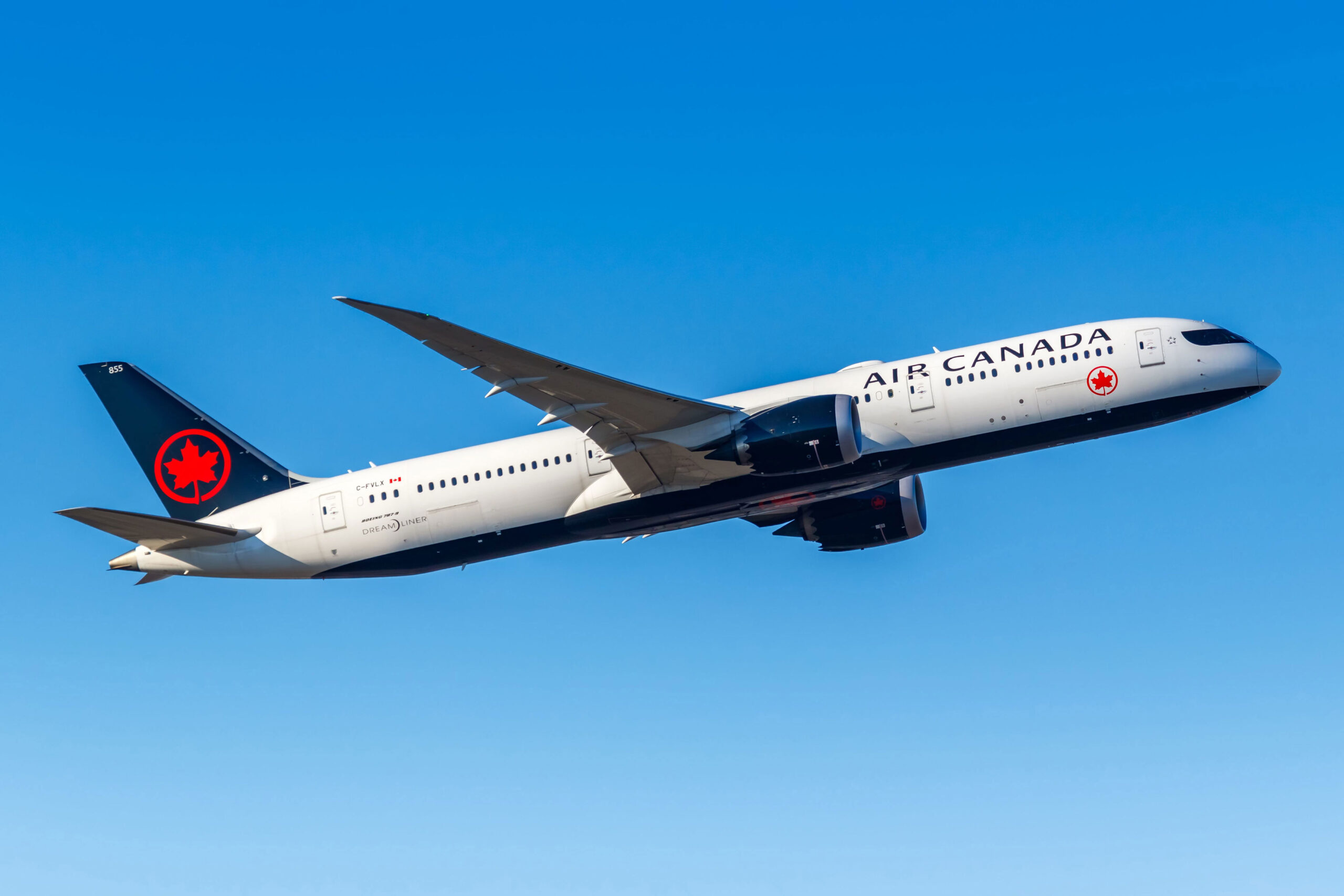
Air Canada last month laid out ambitions for the future of its long-haul fleet with a firm order for eight Airbus A350-1000 widebody jets. These would “be central to the airline’s global expansion,” Air Canada noted at the time, bolstering its nonstop flight offerings to the likes of “the Indian subcontinent, Southeast Asia, and Australia.”
The initial eight A350-1000s delivered will make up the first in Air Canada’s fleet, with the deal leaving the door open for a further eight purchases. These are scheduled to be handed over from Airbus to Air Canada from 2030, marking a huge leap in its fleet modernization plans.
Air Canada’s Fleet Modernization
Details of how Air Canada will put its A350-1000s to use are, naturally, few and far between. However, a look at the airline’s current fleet blatantly shows that replacements will be needed in the near future for several of the aging models it still operates.
For instance, Air Canada boasts 20 Airbus A330s within its long-haul fleet. These average 19.3 years of age, but are far from the oldest within their ranks. Last year, the airline brought two passenger 767-300s back into service on the back of aircraft delivery delays. In total, it still has six such jets, averaging 32.3 years of age.
| Aircraft | Total Number | Average Age |
| Airbus A220 | 42 | 4.1 years |
| Airbus A320 | 16 | 22.6 years |
| Airbus A321 | 22 | 19.5 years |
| Airbus A330 | 20 | 19.3 years |
| Boeing 737 | 51 | 5.8 years |
| Boeing 767 | 6 | 32.3 years |
| Boeing 777 | 25 | 16.3 years |
| Boeing 787 | 40 | 9.1 years |
Perhaps most importantly, though, is the 25 Boeing 777 variants in Air Canada’s fleet. Besides the 787 Dreamliner, these are the backbone of its long-haul operation. However, at an average age of 16.3 years, the airline no doubt has to search for a successor to the 25 777s it still flies, given the usual two-decade lifespan of aircraft.
Replacing The 777
Air Canada’s A350-1000 order, which was disclosed on February 12, appears to have emerged just in time, therefore. Indeed, by the time the first A350-1000s begin to arrive, the average age of Air Canada’s 777s will have edged past the 20-year mark.
Realistically, the A350-1000 makes for a natural successor to the 777-200s and 777-300ERs in Air Canada’s fleet. Similar in both size and capacity, the A350-1000 offers slightly better range but falls short on maximum takeoff weight. Below is a comparison of the 777-300ER, A350-1000 and 787-9. Of the 777s and 787s in its fleet, the 777-300ER and 787-9 make up the majority, accounting for 17 and 30 of the variants respectively.
777-300ER, A350-1000 and 787-9 specifications:
| Specifications | 777-300ER | A350-1000 | 787-9 Dreamliner |
| Length | 73.90 m | 73.78 m | 63.00 m |
| Wingspan | 64.80 m | 64.75 m | 60.17 m |
| Range | 7,884 nmi | 7,992 nmi | 8,313 nmi |
| Engines | 2 GE90-115B | 2 Rolls-Royce Trent XWB-97 | 2 GEnx-1B or Rolls-Royce Trent 1000 |
| Thrust | 230,600 lbf | 194,200 lbf | 142,000 lbf |
| Capacity | 365 pax | 369 pax | 280 pax |
| Max takeoff weight | 351,534 kgs | 308,000 kgs | 252,651 kgs |
Whilst similar across the board, where the A350-1000 really trumps the 777-300ER is in efficiency. Over 50 percent of the A350-1000 is built using carbon composites, making it around 30 to 40 tonnes lighter than the aluminum 777-300ER. Coupled with improved aerodynamics and engine technology, this translates to as much as a 25 percent reduction in fuel burn, making the A350-1000 a far more economically viable option.
Credits: New Air Canada