
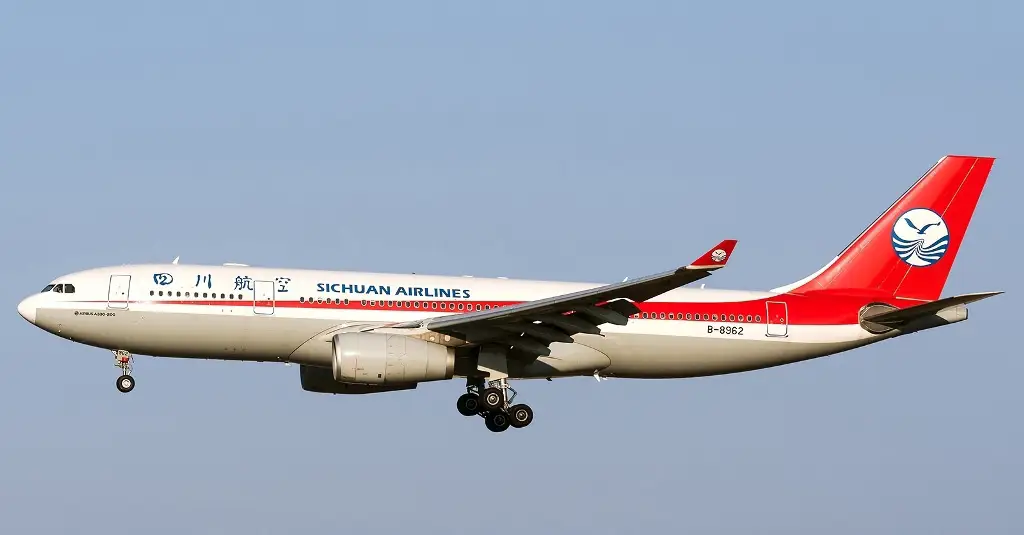
Sichuan Airlines Co., Ltd. is a major Chinese airline headquartered in Chengdu, Sichuan, operating as a full-service carrier with scheduled passenger, cargo, and charter services. As a partially state-owned entity, it is primarily controlled by a consortium including China Southern Airlines (39%), Sichuan Provincial Investment Group (30%), and others, with shares traded on the Shanghai Stock Exchange (ticker: 600115). The airline focuses on connecting Southwest China to domestic and international markets, leveraging its base at Chengdu Shuangliu International Airport (CTU) and secondary hubs at Chongqing Jiangbei (CKG) and Kunming Changshui (KMG). It operates the Golden Panda loyalty program and emphasizes high-quality service, holding a 4-star Skytrax rating. Sichuan Airlines is not part of a global alliance but maintains codeshare agreements with carriers like Air China, Shandong Airlines, and international partners.Key operational details include:
- Fleet: As of September 2025, 210 aircraft, primarily Airbus: 39 Airbus A319s (short-haul, ~132 seats), 85 Airbus A320s (short-haul, ~162 seats), 62 Airbus A320neos (fuel-efficient, ~180 seats), 10 Airbus A321s (short/medium-haul, ~194 seats), 10 Airbus A330-300s (medium/long-haul, ~300 seats), and 4 Airbus A350-900s (long-haul, ~312 seats). It also operates 6 COMAC ARJ21s (regional, ~90 seats), with orders for 20 more ARJ21s and 15 COMAC C919s (deliveries 2025–2030). The fleet supports robust domestic operations and growing international routes.
- Network: Serves over 140 destinations across 20 countries, with ~1,000 routes (90% domestic, 10% international). Major hubs: Chengdu (CTU), Chongqing (CKG), Kunming (KMG). Key international routes include Asia (Tokyo, Seoul, Singapore, Bangkok), Europe (Prague, Helsinki, Cairo via Chengdu), North America (Vancouver, Los Angeles), and Oceania (Sydney, Melbourne). It operates ~1,200 daily flights, carrying ~30 million passengers annually (2024 data).
- Codes and Allowances: IATA code 3U; ICAO code CSC. Baggage: Economy 1x20kg checked + 5kg carry-on (domestic), 2x23kg (international to Americas/Europe); Business/First 2x32kg + 7kg carry-on. Varies by route/class.
- Workforce and Performance: Employs ~15,000 staff. Reported $3.5B revenue in 2024, with $300M net profit, driven by domestic recovery (95%+ pre-COVID levels) and international growth. Golden Panda Club has millions of members, supporting loyalty across subsidiaries like Chengdu Airlines.
Sichuan Airlines positions itself as Southwest China’s leading carrier, emphasizing regional connectivity, premium service, and fleet modernization with COMAC aircraft to align with China’s aviation and sustainability goals.
| Field | Details |
|---|---|
| Name | Sichuan Airlines Co., Ltd. |
| IATA / ICAO / Callsign | IATA: 3U · ICAO: CSC · Callsign: “SICHUAN” |
| Founded | 19 September 1986 |
| Commenced Operations | 14 July 1988 (first flight Chengdu → Wanzhou) |
| Headquarters | Chengdu, Sichuan Province, China |
| Main Hubs / Bases | Chengdu Shuangliu International Airport; Chengdu Tianfu; also Chongqing Jiangbei; Kunming Changshui are major operating bases |
| Ownership / Shareholders | Major shareholder is Sichuan Airlines Group (~40%); others include China Southern Airlines (~39%), China Eastern Airlines (~10%), Air China (~10%), and Chengdu Gingko Restaurant Co (~1%) |
| Fleet Size | Around 190–210 aircraft (mostly Airbus) |
| Number of Destinations | Over 140 destinations (domestic + international) |
| Frequent Flyer Program | Golden Panda |
| Employees | More than 6,000 staff |
| Subsidiaries / Affiliates | Chengdu Airlines; Sichuan Airlines Logistics; Sichuan Aircraft Maintenance Engineering (about 73% ownership) |
Brief History
Founded on May 14, 1986, as Sichuan Airlines, it began operations on September 27, 1988, with domestic flights from Chengdu using leased Xian Y-7 aircraft. Initially a joint venture with CAAC and local investors, it restructured in 2002, with China Southern Airlines and Sichuan Provincial Investment Group taking major stakes. The 1990s saw fleet expansion with Airbus A320s (1995) and international routes to Southeast Asia by 1998.
The 2000s marked growth: Listed on the Shanghai Stock Exchange (2002), introduced A321s (2004), and launched long-haul with A330s (2006). By 2010, it carried 10 million passengers annually, adding A350s (2018) for routes like Vancouver (2012) and Helsinki (2019). The 2008 Sichuan earthquake prompted humanitarian flights, enhancing its regional reputation.
COVID-19 disrupted 2020–2022, with losses of ~$500M in 2020 due to travel bans. Recovery began in 2023, with domestic capacity restored and international routes like Cairo (2023) added. In 2024, it took delivery of its first ARJ21, supporting China’s domestic aircraft push, and reported a $300M profit. By September 2025, it operates 210 aircraft, with plans for C919 integration and expanded European/Asian routes, solidifying its role as a key player in China’s aviation market.
| Year / Period | Event / Milestone |
|---|---|
| 1986 (Sept 19) | Sichuan Airlines Company founded |
| 1988 (July 14) | First commercial flight from Chengdu to Wanzhou; operations begin |
| 1990s onward | Gradual expansion of domestic routes; acquisition of more aircraft; entering international route network over time |
| 2002 (Aug 29) | Reorganized into Sichuan Airlines Co., Ltd.; provincial group becomes major shareholder; other national airlines and stakeholders come in as investors |
| 2010 | Sichuan Airlines Group formally established to manage broader strategy and growth; plans for IPO at some point |
| 2012 | First long‑haul overseas routes begin (for example flights to Vancouver) |
| 2018+ | Continued fleet expansion; introduction of modern Airbus wide‑body aircraft such as A350s; expansion of international destinations; improvement of service quality and network: Asia, North America, Oceanic routes etc. |