
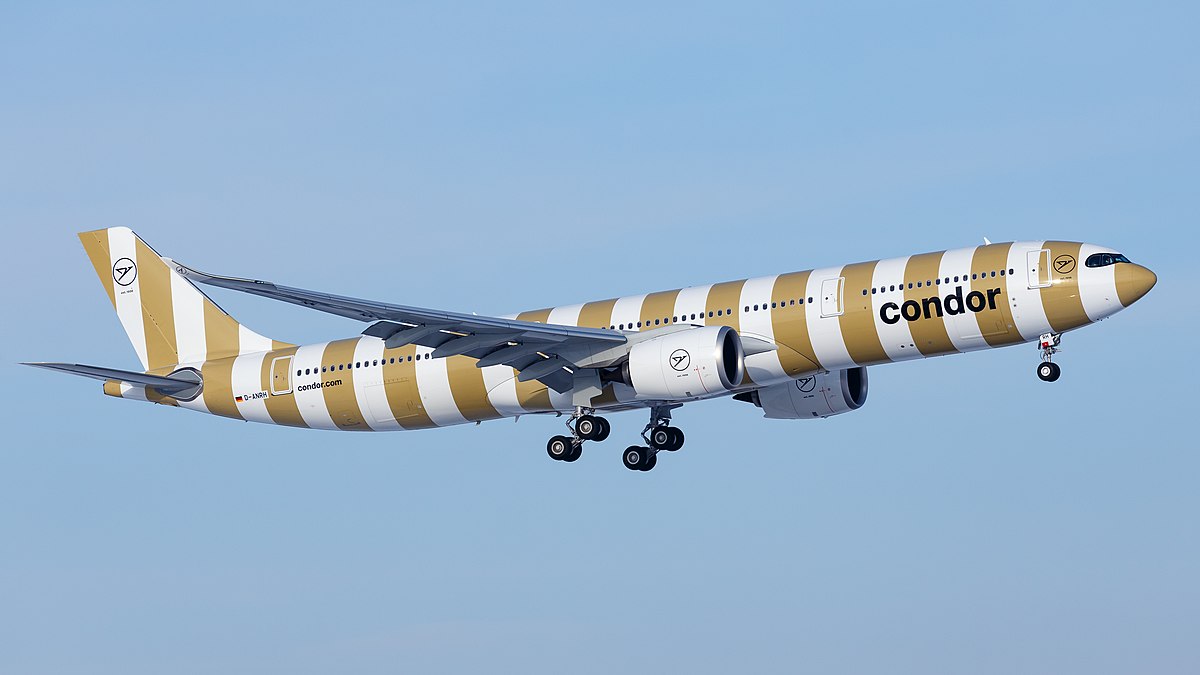
Condor Flugdienst GmbH, commonly known as Condor Airlines, is a German leisure airline specializing in scheduled and charter passenger flights to vacation destinations. Headquartered in Neu Isenburg, Hesse, near Frankfurt Airport (FRA)—its primary hub—it operates from secondary bases in Düsseldorf (DUS) and Munich (MUC). Majority-owned by British investment firm Attestor Capital since 2021 (with additional stakes from Polish Aviation Group and others), Condor is a full-service carrier emphasizing affordable leisure travel, with Business Class and Economy Class offerings. It does not participate in a global alliance but maintains extensive codeshare agreements with partners like Alaska Airlines, Emirates, WestJet, Copa Airlines, and GOL. The airline focuses on sustainability through its all-Airbus fleet transition, targeting reduced CO2 emissions, and offers “Condor Cards” for benefits like priority boarding instead of a traditional frequent-flyer program. It also provides cargo services on select routes and supports tourism with over 9 million annual passengers pre-COVID.Key operational details include:
- Fleet: As of September 2025, 69 aircraft in service (average age ~11.3 years), with 42 on order. Composition: 2 Airbus A319-100s (operated by partners), 20 Airbus A320-200s (10 via ACMI, to be retired), 3 Airbus A320neos (16 more on order), 13 Airbus A321-200s (to be retired), 6 Airbus A321neos (26 more on order), and 18 Airbus A330-900neos (7 more on order, expanding to 25 by 2031). The Boeing 757-300s (7 in service) are retiring by November 2025, completing the shift to an all-Airbus fleet. The A330-900neo, with Rolls-Royce Trent 7000 engines, achieves 20% lower emissions and 2.1 liters fuel per passenger per 100 km.
- Network: Serves 94 destinations across Europe, North America, Africa, Asia, the Caribbean, and South America, with ~300 routes (primarily leisure-focused). Key short/medium-haul: Mediterranean (e.g., Majorca, Greece, Turkey), Canary Islands, North Africa. Long-haul: North America (12 destinations like Miami, Las Vegas, Vancouver, Calgary; seasonal from late April), Caribbean (Cancún, Punta Cana), Africa (Cape Town, Mauritius, Johannesburg), Asia (Bangkok, Phuket). Summer 2025 expansions include daily Frankfurt flights to Rome, Milan, Prague, Vienna, Zurich, Berlin, Hamburg, and Munich; new Vienna routes to Rhodes, Kos, and Palma. Withdrawals: All Cuba routes and six North American cities (San Antonio, Phoenix, Baltimore, Minneapolis, Halifax, Edmonton) due to demand and legal issues. Operates ~2,500 weekly flights.
- Codes and Allowances: IATA code DE; ICAO code CFG. Baggage: Economy 1x23kg checked + 8kg carry-on (short-haul), 2x23kg checked (long-haul); Business 2x32kg checked + 10kg carry-on. Children 5+ may travel unaccompanied (escort service required 5–11); infants under 2 occupy no seat but must be booked.
- Workforce and Performance: Employs over 4,900 staff (including ~5,500 total across operations). Transported >9 million passengers annually pre-2024; 2023/24 fiscal year (ending September 30, 2024) reported €62M net loss (down 50% YoY), with on-time performance at 88%. Focus on profitability via fleet renewal and city expansions amid competitive pressures.
Condor positions itself as Europe’s leading leisure airline, blending vacation escapes with urban getaways while prioritizing eco-efficient growth.
| Field | Details |
|---|---|
| Name | Condor Flugdienst GmbH (branded “Condor”) |
| Type | German leisure / holiday airline |
| Founded | Founded in December 1955 (as Deutsche Flugdienst GmbH) |
| Headquarters / Main Base | Frankfurt am Main, Germany |
| Fleet & Aircraft Types | Mixed fleet: Airbus narrow‑bodies (A320, A320neo, A321, A321neo), Airbus A330‑900neo for long haul, plus some older types to be phased out (e.g. Boeing 757) |
| Destinations & Network | Operates to around 90+ holiday destinations globally, including Europe, Americas, Africa; main departure points include airports in Germany, Austria, Switzerland |
| Annual Passenger Volume | Roughly 9‑10 million passengers per year (pre‑pandemic / recent stable years) |
| Frequent Flyer / Loyalty | Has partnership / interline / codeshare arrangements with other airlines; offers a “Condor Card” loyalty‑style program rather than traditional mileage‑based frequent flyer |
| Alliance / Partnerships | Not a member of a major global alliance; cooperates with producers and partner airlines for network expansion |
| Fleet Renewal & Sustainability | Undergoing fleet modernization: acquisition of efficient aircraft (e.g. A330‑900neo for long haul; large orders of A320neo / A321neo for short/medium haul) to improve fuel efficiency and reduce emissions |
| Regulatory / Safety Certification | Maintains its own maintenance organization; adheres to European aviation safety standards; recognized for reliability in the leisure airline sector |
Brief History
Condor was founded on December 21, 1955, as Deutsche Flugdienst GmbH by shipping lines Norddeutscher Lloyd and Hamburg America Line, alongside Lufthansa and Deutsche Bundesbahn, to serve the growing tourism market. It launched its first tourist flight on March 29, 1956—a pilgrimage to the Holy Land—followed by routes to Majorca and the Canary Islands. By 1959, Lufthansa acquired full ownership. In 1961, it merged with rival Condor-Luftreederei, adopting the Condor name and dominating 63% of Germany’s tourism air travel, carrying 66,000 passengers.
The 1960s–1970s saw international expansion: First long-haul to Thailand, Sri Lanka, Kenya, and the Dominican Republic (1966); pioneered Boeing 747 “Jumbo” operations as the first leisure carrier (1971). By 1973, its fleet included 14 Boeings. In 1989, it introduced direct seat sales via “Condor Flüge Individuell.” The 1990s integrated Südflug, added Boeing 757/767s with two-class cabins, and became part of C&N Touristik under Lufthansa-Karstadt-NUR.
The 2000s–2010s focused on growth within Thomas Cook Group (acquired 2002): Fleet expanded to 12 Boeing 767s; merged with Thomas Cook Airlines entities (2013); introduced A321s (2012). Challenges included the 2019 Thomas Cook collapse, prompting a €380M Polish Aviation Group loan for survival. COVID-19 brought further strain, with government aid and near-bankruptcy.
The 2020s marked renewal: Attestor Capital took majority control (2021); new livery and A330-900neo deliveries began (first flight December 27, 2022). Completed long-haul fleet renewal (18 A330neos, 2024); short/medium-haul refresh started (43 A32Xneos by 2029). Key 2025 events: Boeing 757 retirement (farewell flight November 5); four more A330-900 orders (July); summer network expansions to eight European cities and Panama City, offset by Cuba/North America cuts due to a 2024 court ruling ending Lufthansa feeder ties. By September 2025, Condor operates 69 aircraft, emphasizing sustainable leisure travel with >100,000 passengers on new routes.
| Year / Period | Milestone / Event |
|---|---|
| 1955 | Company established by several German entities under the name Deutsche Flugdienst GmbH; initial fleet small propeller aircraft. |
| 1956 | First tourism / holiday flights begin; early routes include destinations in Spain, Canary Islands, etc. |
| 1960s‑1970s | Expansion into long‑haul exotic destinations; introduction of larger jet aircraft; growth as a major German holiday carrier. |
| 2000s | Became more integrated with major tour operators; adjustments in branding; fleet modernization begins slowly. |
| 2009‑2010s | Introduced premium economy class on long‑haul; added more modern amenities; responded to competitive pressures. |
| 2019 | Thomas Cook collapse affected Condor (as the parent group collapsed), but Condor continued operations under restructuring / protective proceedings. |
| 2021 | Change in ownership; airline taken over by new investors; placed new orders for modern long‑haul aircraft (A330‑900neo) and for short/medium haul neo‑family aircraft. |
| 2022‑2024 | Completion of long‑haul fleet renewal; first deliveries of A330‑900neo; ongoing replacement of older aircraft. Branding refreshed. |
| 2024‑2028 (Planned) | Short and medium‑haul fleet renewal with dozens of A320neo / A321neo aircraft, aiming to modernize and boost efficiency and comfort. |