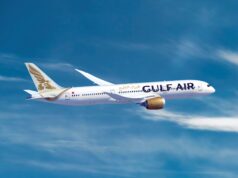

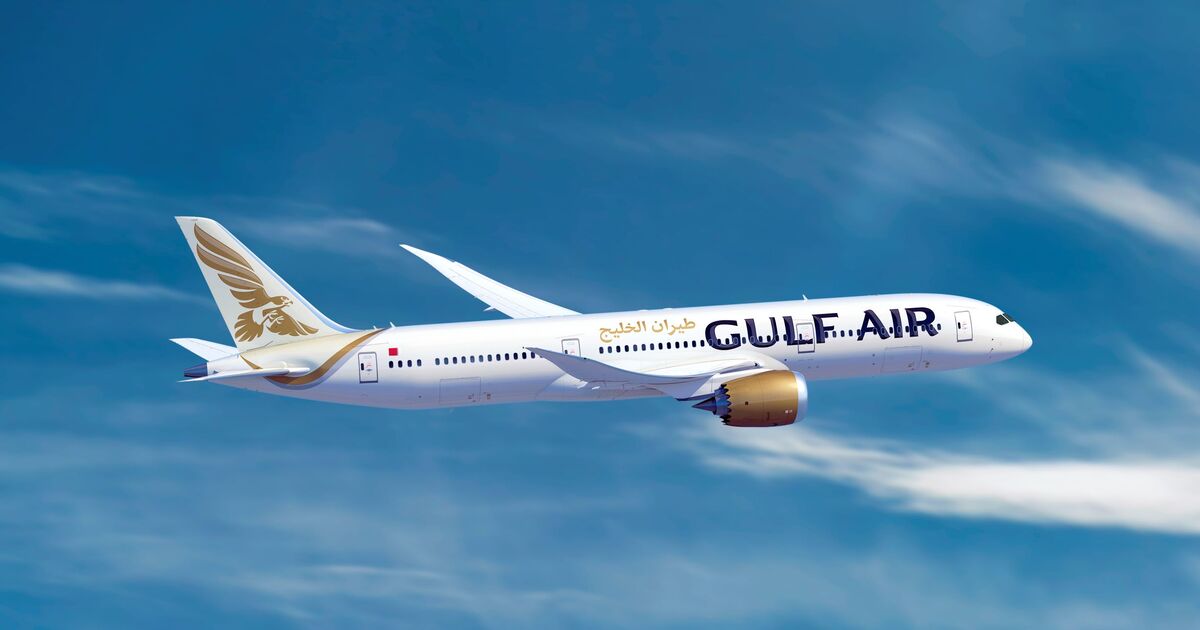
Gulf Air Bahrain B.S.C. (c) is the flag carrier and largest airline of Bahrain, operating as a full-service carrier with scheduled passenger, cargo, and charter flights. Headquartered at Bahrain International Airport (BAH) in Muharraq, it is wholly owned by the Bahrain Mumtalakat Holding Company (Bahrain’s sovereign wealth fund) since 2007. As a oneworld connect partner (full membership pending), it connects the Gulf region to global markets, emphasizing Arabian hospitality through its Falcon Gold (Business) and Economy classes, with features like enhanced lounges and in-flight entertainment. The airline sponsors major events like the Bahrain Grand Prix and Bahrain International Airshow, and focuses on sustainability via fleet modernization. It offers the Falcon Flyer loyalty program and codeshares with partners like American Airlines, British Airways, and Cathay Pacific.Key operational details include:
- Fleet: As of September 2025, 42 aircraft, comprising 26 Airbus A320-200s/A321-200s (narrow-body, ~132–185 seats for short/medium-haul), 6 Airbus A320neos/A321neos (fuel-efficient narrow-body, ~164–186 seats), and 10 Boeing 787-9 Dreamliners (wide-body, ~300 seats in two classes for long-haul). Recent additions include two A321neos in 2024; nine more A320-family and two 787-9s are scheduled for delivery by 2027. In July 2025, Gulf Air signed for 12 Boeing 787 Dreamliners with options for six more (up to 18 total), aiming for an all-787 widebody fleet to expand international capacity.
- Network: Serves 51 destinations in 28 countries across Africa, Asia, and Europe, with ~60 routes from its Bahrain hub. Key short/medium-haul: Middle East (Dubai, Doha, Riyadh), Europe (London-Heathrow, Paris-CDG, Frankfurt, Milan), South Asia (Mumbai, Delhi, Colombo). Long-haul expansions for 2025 include non-stop Manama–New York (JFK) and Manama–Houston (IAH) starting summer 2025 (first U.S. routes in nearly 30 years), plus potential China additions. Network revamp targets 25% more destinations within five years, with visible changes by late 2025; operates ~500 weekly flights.
- Codes and Allowances: IATA code GF; ICAO code GFA. Baggage: Economy 1x23kg checked + 7kg carry-on (short-haul), 2x23kg checked (long-haul); Falcon Gold 2x32kg checked + 10kg carry-on. Infants under 2 get 10kg checked; specifics vary by route.
- Workforce and Performance: Employs ~3,000 staff. Carried 6.2 million passengers in 2024 (+5.4% YoY), with load factor ~80%; 2024 revenue details not public, but focused on profitability after years of losses. H1 2025 shows growth amid network recalibration; ranks among top Gulf carriers by flight hours (part of the top 10 with ~6% share).
Gulf Air positions itself as Bahrain’s global ambassador, prioritizing network growth, fleet efficiency, and premium Gulf hospitality to reclaim regional leadership.
| Field | Details |
|---|---|
| Name | Gulf Air |
| IATA / ICAO / Callsign | IATA: GF · ICAO: GFA · Callsign: “GULF AIR” |
| Founded | 24 March 1950 (as Gulf Aviation) |
| Headquarters / Main Hub | Muharraq, Bahrain · Bahrain International Airport |
| Ownership | State‑owned; sole shareholder is Gulf Air Holding (linked to Bahrain sovereign / national investment entities) |
| Fleet Composition | Mixed fleet: narrow‑body Airbus A320 / A321 / A320neo family; wide‑body Boeing 787‑9 Dreamliners |
| Destinations | ~50‑51 destinations in ~30 countries across Asia, Africa, and Europe |
| Frequent Flyer Program | Falconflyer |
| Key People | Chairman: Khalid Hussain Taqi; Group CEO: Jeffrey Goh |
| Service Offering | Full service carrier; premium cabin (“Falcon Gold”), economy; Arabian hospitality; lounges; region‑spanning network |
Brief History
Gulf Air was founded on March 24, 1950, as Gulf Aviation Company by British aviator Freddie Bosworth in Bahrain, starting with air taxi services to Doha and Dhahran using de Havilland DH.86 biplanes and Avro Ansons. In 1951, BOAC acquired a 22% stake, enabling expansion with Fokker F27s and BAC One-Elevens by the early 1970s, serving regional hubs and London via Vickers VC10s.
In 1974, the governments of Bahrain, Qatar, Abu Dhabi, and Oman bought out BOAC, forming Gulf Air as a joint flag carrier with equal shares, inheriting VC10s and adding Lockheed L-1011 Tristars and Boeing 737s. By 1976, it expanded to 20+ destinations including Bangkok, Delhi, and Paris. The 1980s brought Boeing 767s (1988) and routes to Frankfurt, Nairobi, and Sydney (first Arab airline to Australia, 1990); joined IATA in 1981.
The 1990s introduced Airbus A340-300s (1994) and New York services (discontinued 1997); celebrated 40 years with no-smoking policy (1998). Qatar’s 2002 withdrawal shifted focus to Bahrain/Abu Dhabi/Oman hubs; Abu Dhabi exited in 2005, Oman in 2007, leaving Bahrain sole owner amid restructuring and a new gold-blue livery (2003). Profits returned briefly in 2004 (BD1.5M) despite a fatal Flight 072 crash (2000, 143 deaths).
The 2010s emphasized modernization: Ordered Boeing 787s and Airbus A320/A330s (2008); launched Falcon Gold cabin (2010); suspended flights during Bahrain uprising (2011, resumed Iran 2014). Phased out A340s (2012) and A330-200s (2020); ordered A321neo/A320neo (2016); suspended Qatar routes (2017 crisis); unveiled new livery (2018). COVID-19 led to capacity cuts, but recovery included Bahrain Airshow sponsorship.
By 2024, fleet reached 42 with two A321neos added, carrying 6.2M passengers. In 2025, Gulf Air announced 18 Boeing 787 orders (July), U.S. route launches (summer), and new CEO Martin Gauss (November 4, ex-airBaltic); network revamp targets profitability by late 2025, solidifying its role as Bahrain’s aviation pioneer.
| Year / Period | Event / Milestone |
|---|---|
| 1950 | Founded as Gulf Aviation, small regional operations between Bahrain and nearby Gulf destinations |
| 1974 | Reorganization: Bahrain, Qatar, Abu Dhabi, and Oman governments acquired shares; airline becomes “Gulf Air,” jointly owned by those states |
| 1970s–1980s | Expansion of route network to major international cities; introduction of larger aircraft such as Lockheed L‑1011 TriStar and Boeing 737 series |
| 1990s | Further expansion; addition of long‑haul aircraft; launching of flights to Europe, Asia; adoption of newer wide‑body types (e.g. Airbus A340) |
| 2000s | Disengagement of partner states: Abu Dhabi, Qatar, Oman gradually withdrew ownership and set up their own flag carriers; Bahrain becomes sole owner |
| 2006‑2007 | Major structural changes; Abu Dhabi, Oman leave consortium; Bahrain assumes full ownership; refurbishment of service and fleet modernization begins |
| 2010s | Restructuring to improve profitability; introduction of upgraded cabins; premium services; fleet renewal; phasing out of older wide‑body types |
| 2020‑2023 | Continued network refinement; focus on operating efficiency; adjusting route network; gradual growth; addition of modern aircraft to fleet; aiming for upmarket positioning in regional and long‑haul markets |