
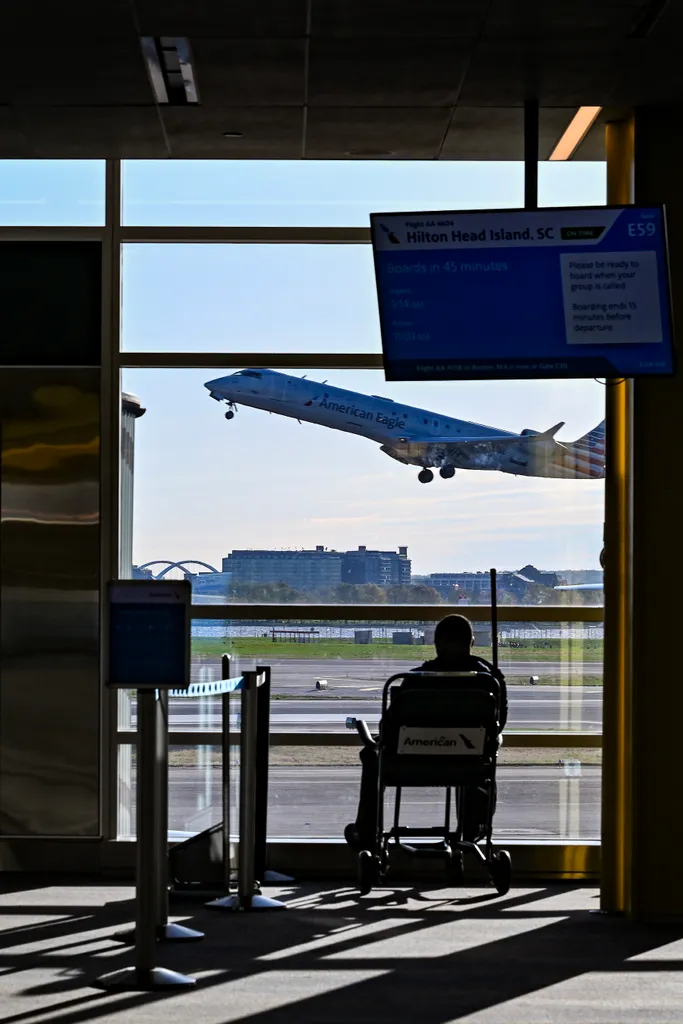
Compensation for disrupted flights. Refunds for faulty services such as broken Wi-Fi. Transparent airfares, and certain protections for disabled travelers whose wheelchairs are damaged. All were airline passenger protections championed by the Biden administration. Now it looks as if the Trump administration is seeking to roll them back.
Recent filings by the Transportation Department indicate that it is looking to loosen aviation industry rules — something the nation’s largest carriers have increasingly pushed for — undoing the policies of the previous administration.
While some rules covering passenger rights are set to be eliminated, others have been flagged for updates, according to the agenda of proposed regulatory changes released last week.
The Transportation Department and Airlines for America, a trade group representing the country’s biggest carriers, argue that these rollbacks are course correcting from years of government overreach.
A federal law in 1978 granted airlines the authority to set routes and fares without heavy governmental intervention, reversing a long-established norm. Proponents of deregulation emphasized that increased competition would lower fares and bring in new routes and carriers.
Whether this was a success depends on whom you ask. Airlines for America said in a federal filing in May in response to a government request for comment from the public that deregulation accomplished many of its goals. But Ganesh Sitaraman, a professor at Vanderbilt Law School and the author of a book on airline deregulation, believes that it created an unregulated oligopoly and an aviation system with unreliable service.
“The reality is that we did not end up in that kind of dream world that the deregulators imagined,” Sitaraman said. “It’s a system in which there often isn’t a lot of competition,” he added. “The prices aren’t often that great. Sometimes the service isn’t great.”
Since deregulation, regional and budget airlines have struggled. Airlines merged and built up hub-and-spoke models, granting them dominance on key routes.
Meanwhile, consumer advocates say the passenger experience has deteriorated. Airplanes are more crowded and seats narrower. Different categories of fares have proliferated, and some services, such as baggage and seat selection, are no longer free.
Advocates for passenger rights celebrated the Transportation Department’s efforts during the Biden administration to shore up consumer rights through policy. Among those changes: requiring airlines to promptly pay for damaged wheelchairs, to give automatic cash refunds for significant flight disruptions under an airline’s control, and to allow families to sit together for free.
Some of these rules took effect. Others introduced in the final months of the last administration have largely stalled or been stymied by litigation filed by the airlines.
The Transportation Department is responsible for enforcing aviation consumer rules. Without its push to protect passengers, consumers are on shakier ground, said William McGee, a senior fellow for aviation at the American Economic Liberties Project, a progressive-leaning nonprofit that opposes monopolistic practices.
“Since deregulation in 1978, consumers have fewer rights with airlines than with any other industry. State courts, legislatures and attorneys general have zero authority over airlines,” McGee added. “The DOT secretary is the only sheriff in town, and if the secretary is on the side of the airlines, then consumers are out in the cold.”
In April, the Transportation Department solicited public input — including from businesses and lobbyists — about what rules, regulations and reporting requirements ought to be discarded. The notice encouraged commenters to focus on where the government could achieve “meaningful regulatory cost reduction” through deregulation — including, potentially, by reducing the amount of data it collects. Within weeks, nearly 1,000 entities, including several airlines, airline executives and trade associations, weighed in.
But the submission from Airlines for America, the industry trade group, stood out. Clocking in at 93 pages, it was a diatribe against a swath of Biden-era regulations concerning the rights of airline passengers.
“This activist agenda has stifled innovation, capitalism and efficiency, raised prices for consumers, and inhibited consumers’ ability to choose an airline with their wallets,” Airlines for America wrote in its comment. “Now is the time for the re-deregulation of the airline industry that can unleash American prosperity and the new ‘golden age’ of air travel in America.”
Among the airlines’ priorities are eliminating the rules requiring airlines to reveal “junk” fees before booking — which they tried to block in a lawsuit — and making them liable for damaged wheelchairs, clawing back refund rules, and ending “baseless and unfair” investigations into airlines. They also want to reduce the amount of data they are required to publicly report, which includes statistics such as on-time performance, mishandled baggage and tarmac delays.
Advocates for consumer rights and fair-pricing experts said the Transportation Department’s apparent openness to the airlines’ demands to roll back protections for passenger rights is a sign of what’s to come.
Lindsay Owens, executive director of Groundwork Collaborative, a progressive economic think tank, said she fears that airlines will next seek to roll back other rules, such as ones mandating automatic refunds for severely disrupted flights and refunds for significantly delayed bags and ancillary services that weren’t provided.
Credits: The Seattle Times