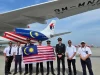

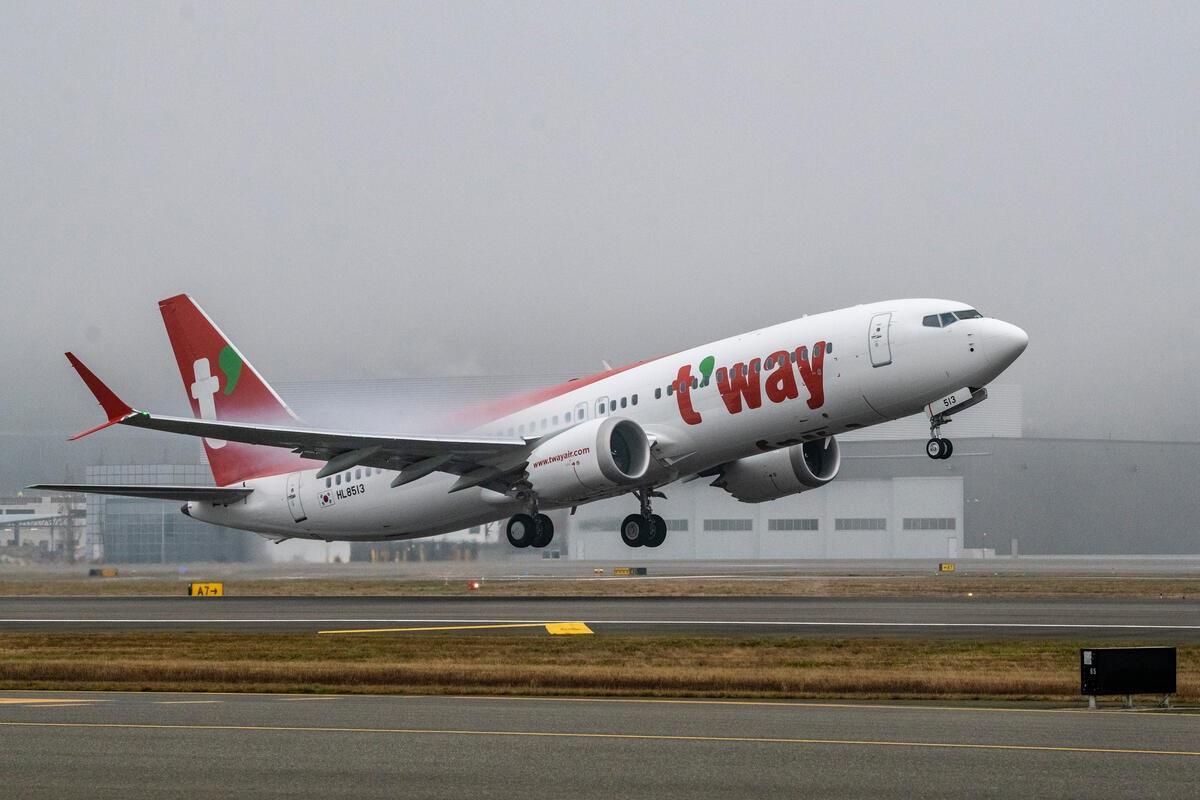
South Korean low-cost carrier T’way Air is set to be renamed as Trinity Airways. This follows the acquisition of the carrier in June 2025 by the Daemyung Sono Group, a large hotel and resort conglomerate. The group says that the name change and brand renewal are part of efforts to ready the carrier for further global expansion, and that the redesign of aircraft exteriors will be rolled out in the first half of 2026.
T’Way Air was founded 20 years ago as South Korea’s first low-cost carrier, and is one of the country’s three major domestic LCCs alongside Jeju Air and Jin Air. It has embarked on a period of international expansion over the past few years, including the addition of multiple routes to Europe, North America, and Oceania. The carrier now serves 46 destinations from its hubs at Incheon International Airport and Gimpo International Airport in Seoul.
A Full Rebrand By 2026
Daemyung Sono is the largest resort operator in South Korea, with over 18 hotels and resorts nationwide, with more than 11,000 rooms. The group also has a minority stake in Air Premia, a South Korean long-haul LCC. Its acquisition of T’Way Air was approved by South Korea’s Fair Trade Commission in June 2025, and it stated at the time that its primary objective was to inject capital and drive growth. The rebranding to Trinity Airways, set for full rollout in the first half of 2026, includes a complete overhaul.
This will see the carrier given a new name, redesigned aircraft exteriors, updated uniforms, and a refreshed brand identity. The airline says the primary motivation is preparing the airline for ongoing fleet expansions and route additions. But it will also be about shedding the budget-only image of T’Way Air, and positioning the airline as a hybrid carrier, blending LCC efficiency with premium elements on long-haul flights to appeal to a broader customer base. A T’way Air official told Chosun Daily that the rebranding is also a part of the driving broader integration and synergies across the group:
“This name change will mark the starting point for realizing substantial synergy between T’way Air and Daemyung Sono Group, now as one family. The two companies plan to launch strategic collaborations combining air routes spanning Asia, Europe, and the Americas with hotel and resort infrastructure, as well as differentiated package products beyond the domestic market.”
The Evolution Of T’Way Air
The origins of T’way Air trace back to 2005, when it was established as Hansung Airlines, a regional low-cost operator connecting smaller cities and islands to major hubs using ATR 72-500 turboprop aircraft. However, the fledgling carrier ran into immediate difficulties operating in a highly competitive environment, and, by 2009, had ceased operations amid the global financial crisis.
Still, in 2010, the airline was reorganized under new management and rebranded as T’way Air. The name ‘T’way’ was derived from “together, today, and tomorrow,” symbolizing unity and forward-looking aspirations, and is the inspiration behind the Trinity Airways name. The airline positioned itself for price-sensitive travelers and moved to fully jet-based operations, starting with a fleet of Boeing 737-800s.
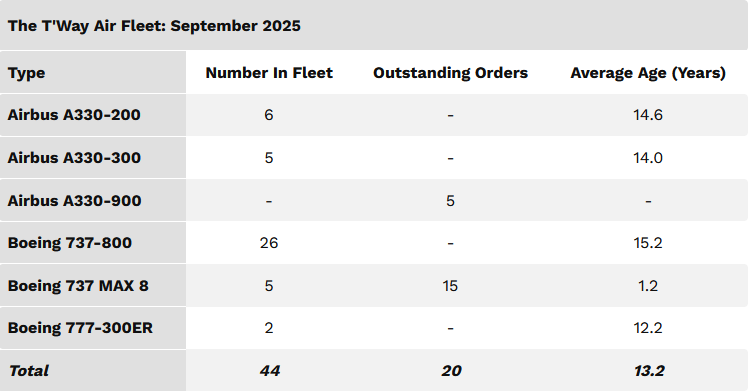
The 737-800s remain the core of the fleet, but T’way is supplementing these with an order for 20 MAX 8s that will be fully delivered by 2027. In recent years, the carrier has grown its network with long-haul international routes, and so has also built out a widebody fleet, as detailed below.
- A330-200: Leased from Korean Air, these have 246 seats with 18 premium recliner seats up-front.
- A330-300: Ex-Aeroflot and AirAsia X aircraft, these have up to 377 seats with 12 premium recliner seats up-front.
- A330-900: Order for five next-generation A330s to be delivered from next year. Fleet expansion by the Daemyung Sono Group will very likely increase the size of this order.
- 777-300ER: Also leased from Korean Air to fill the gap while the airline awaits its A330-900 deliveries.
Credits: t’Way Airline