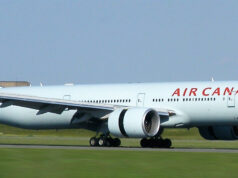

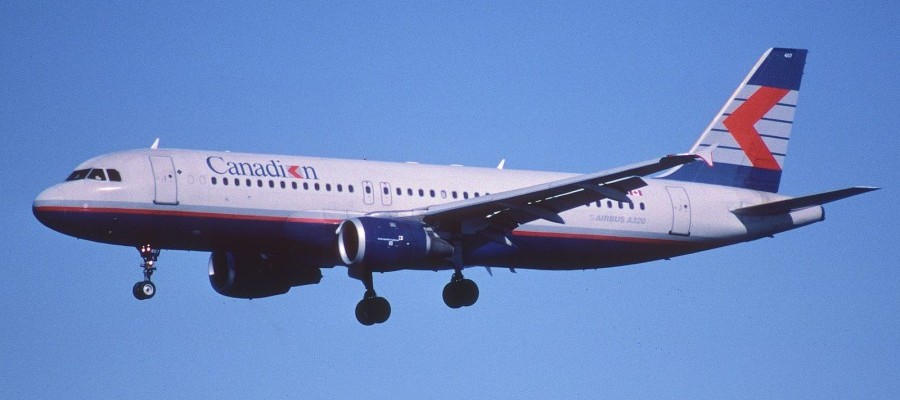
Canadian Airlines International Ltd. (often referred to simply as Canadian Airlines) was Canada’s second-largest airline, operating as a full-service carrier with scheduled passenger, cargo, and charter flights. Headquartered in Calgary, Alberta, it served as the principal subsidiary of the Canadian Airlines Corporation and positioned itself as a key competitor to Air Canada, with a strong focus on international routes, particularly as a gateway between North America and Asia via its Vancouver hub. At its peak in 1996, it carried over 11.9 million passengers to more than 160 destinations in 17 countries across five continents, generating approximately $3 billion in revenue by the end of 1999. The airline was a founding member of the Oneworld alliance from 1999 to 2000 and pioneered innovations like being the first airline worldwide to launch a website (www.cdnair.ca) (www.cdnair.ca) in April 1994 and banning smoking on all domestic flights in 1987. It offered three classes of service: First Class, Business Class, and Canadian Class (Economy on turboprops). Subsidiaries included Canadian Holidays (a major tour operator) and Canadian Air Cargo (for general air cargo services).Key operational details include:
- Fleet: At the time of its acquisition in 2001, the fleet totaled 97 mainline aircraft: 13 Airbus A320-200s, 43 Boeing 737-200/Adv, 4 Boeing 747-400s, 23 Boeing 767-300ERs, and 14 McDonnell Douglas DC-10-30s. It also managed a regional fleet through partnerships, including turboprops and regional jets, which later contributed to the formation of Canadian Regional Airlines.
- Network: Operated from major hubs at Montréal-Dorval (now Montréal-Pierre Elliott Trudeau) International Airport, Toronto Pearson International Airport, Vancouver International Airport, and Calgary International Airport. It served 105 destinations in Canada and extended internationally, with a focus on Asia (seven destinations, more frequent than any other Canadian carrier at the time, including the last addition to the Philippines). Routes spanned Europe, the Caribbean, South America, and trans-Pacific services.
- Codes and Allowances: IATA code CP; ICAO code CPN. Frequent-flyer program: Canadian Plus, Canada’s largest with over three million members and more than 60 worldwide partners. Baggage and other allowances followed standard practices of the era, though specifics varied by class.
- Workforce and Performance: Employed thousands across operations, with a market share of over 40% of domestic passengers in Canada at merger. It faced financial volatility but achieved restructuring milestones in the 1990s.
Canadian Airlines emphasized global connectivity and innovation but ultimately succumbed to industry consolidation.
| Field | Details |
|---|---|
| Name | Canadian Airlines International (often called Canadian Airlines) |
| IATA / ICAO Codes | IATA: CP, ICAO: CDN |
| Callsign | “CANADIAN” |
| Founded | March 27, 1987 (through amalgamation of carriers) |
| Ceased Operations / Fate | Acquired by Air Canada; merger integrated on January 1, 2001 |
| Headquarters | Calgary, Alberta, Canada |
| Hubs | Calgary; also major operations in Montréal‑Dorval and Montréal‑Mirabel; Toronto Pearson; Vancouver |
| Focus Cities | Edmonton, Halifax, Ottawa |
| Frequent Flyer Program | Canadian Plus |
| Fleet & Destinations (at peak) | Carried ~11.9 million passengers; served over 160 destinations in 17 countries across five continents (in 1996) |
| Parent | Canadian Airlines Corporation |
Brief History
Canadian Airlines International was formed on March 27, 1987, through the amalgamation of Pacific Western Airlines—which had recently acquired Canadian Pacific Air Lines (founded in 1942 as a subsidiary of the Canadian Pacific Railway), Eastern Provincial Airways, and Nordair—creating a unified entity to compete with Air Canada in a deregulated market.
In 1989, it expanded internationally by acquiring Wardair, gaining routes to the UK and Europe. The early 1990s brought challenges from the 1991 industry slump, resulting in over $700 million in debt; restructuring was supported by cash injections from AMR Corp. (parent of American Airlines). In 1996, under President and CEO Kevin Benson, a four-year plan focused on cost control, revenue growth, fleet renewal, and capitalization, though it was hampered by the 1997 Asian financial crisis, causing losses on trans-Pacific routes.
The late 1990s saw intense takeover battles: In 1999, Air Canada proposed acquiring its international routes and slots, but this was rejected. On August 24, 1999, Onex Corporation, backed by AMR, launched a $1.8 billion cash and $3.9 billion debt-assumption bid, which Canadian supported. Air Canada countered with a $930 million offer backed by Star Alliance partners Lufthansa, United Airlines, and CIBC. A Quebec judge ruled the Onex bid illegal on November 5, 1999, due to foreign ownership limits (no more than 10% by a single shareholder), prompting Onex’s withdrawal. Air Canada proceeded, gaining control on December 8, 1999 (pending approval), and officially making Canadian a subsidiary on December 23, 1999.
Canadian operated as a subsidiary through most of 2000, with full integration of systems and employees completed by October 2000. It ceased independent operations on January 1, 2001, fully merging into Air Canada, which announced 3,500 workforce cuts on December 22, 2000, and another 5,000 on September 26, 2001, exacerbated by the 9/11 attacks. Post-merger, Air Canada dominated over 90% of domestic traffic, absorbing the fleet (some aircraft served until 2020 or were converted for cargo), routes, and the Canadian Plus program. As of 2025, Canadian Airlines no longer exists as an independent entity, with its legacy integrated into Air Canada, Canada’s flag carrier.
| Year / Period | Event / Milestone |
|---|---|
| 1987 | Canadian Airlines was formed by merging several regional and national carriers; started operations under that name. |
| 1990s | Rapid expansion domestically within Canada, and internationally; became second largest airline in Canada. |
| 1996 | Peak passenger numbers: ~11.9 million; served 160+ destinations in 17 countries. |
| Late 1990s | Financial pressures, competition with Air Canada and others increased; cost, route rationalization issues. |
| 2000 | Air Canada announced acquisition of Canadian Airlines. |
| 2001 Jan 1 | Officially merged into Air Canada; Canadian Airlines ceased to exist as independent carrier. |