Home Air Canada Air Canada Reveals Stunning New Cabins — What Its COO Told Me...

Air Canada Reveals Stunning New Cabins — What Its COO Told Me About The Design Choices And Fleet Plans

30
0
credits: Air Canada

Air Canada has just unveiled the new cabins for its Boeing 787-10 and Airbus A321XLR aircraft that will be coming into the fleet, and its new “Glowing Hearted” design language. I spoke to the airline’s Executive Vice President and Chief Operating Officer, Mark Nasr, to learn more about the products and the airline’s plans to carry those through the rest of its fleet.

We’ve seen a lot of new product refreshes – within the last year American Airlines debuted their new Boeing 787-9 business class and their Airbus A321XLR. United Airlines introduced their new 787-9 Polaris cabin. Delta just announced new business products on its Airbus A350-1000 and a better – but 9 year old seat – for their Airbus A330s. This is a very competitive business, and Air Canada’s new cabins look fantastic.

From video, imagery and descriptions it’s clear that the details matter. Air Canada doesn’t just lead with product attributes like bed size, they highlight “red stitching and bespoke fabrics provide a subtle Canadian touch paired with a palette of greys and stone.” “Natural wood grain details are complemented by bronze metal accents.” “Leather-grain surfaces and metal finishes.”

This product is about the details in design, and I’m here for it.

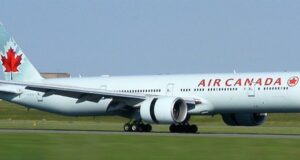
Air Canada’s New Boeing 787-10s

Air Canada has a firm order for 14 aircraft, each with 332 seats:

  • 42 business class seats (4 of which are ‘Signature Plus Suites’)
  • 28 premium economy seats
  • 262 economy seats

The business class seat is the Elevate Ascent (née Adient Ascent) used by both their joint venture partner United Airlines for its new Polaris Suite, as well as by Qatar Airways on its Boeing 787-9, American Airlines and Alaska Airlines. The differences, then, are in customization.

These feature:

  • A 27-inch 4K OLED in-flight entertainment screen with Bluetooth audio.
  • A quartzite stone table and a guest seat for visits while at cruising altitude.
  • Two centre suites with a fully retractable sliding privacy panel, creating an open social space for up to four (for use at cruise only).
  • Seats with multiple high-powered USB-C and AC outlets.

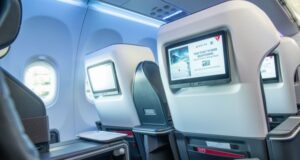
Business class offers what’s become standard for top of the industry products – lie flat direct aisle access with privacy panels, a 19-inch 4K screen with bluetooth, as well as multiple AC and USB-C outlets.

Premium economy Recaro seats have privacy wings creating a sense of separateness from the cabin, since you don’t see your neighbors so much (even if someone walking down the aisle would see you). There are 16-inch 4K entertainment screens with bluetook, AC and USB power, and seat storage as well as bottle holders.

Coach has 13-inch entertainment screens with bluetooh, AC and USB power. The seats have tablet holders.

Air Canada expects their first Boeing 787-10 to enter service by end of the year. As their most premium aircraft we can expect it to fly premium routes, so London Heathrow is a good bet to start.

Air Canada’s New A321XLRs

Air Canada’s order of 30 Airbus A321XLRs will allow narrowbody planes to fly long distances – short transatlantics from the East Coast of Canada (Montreal and Toronto), premium routes across Canada, and between Canada and the United States.

This plane should fly on routes like Montreal and Toronto to Tenerife (a rare winter route to Europe), to Berlin and to Palma de Mallorca. A coming update to the Pratt & Whitney geared turbofan engine should give them additional thrust and range. It will begin by flying transcon routes within Canada.

  • 14 business class seats
  • 168 coach seats

Business class will offer lie flat seats on the Collins Aurora platform with direct aisle access, one seat on each side of the aisle. These will be suites with privacy panels, along with wireless charging and AC and USB-C power and 19 inch 4K entertainment screens with Bluetooth audio..

There are no doors on the XLR suite. Mark Nasr told me that it’s easier to put the door on, since other airlines already have a door on that seat platform. They had to do additional design and certification work without it – but it gets them a bed that’s 2 inches longer on either side, and the cabin aisle is 5 inches wider at elbow level.

Plus, the oversized Airspace bins come down so far, that the doors can’t be very tall, and don’t provide much privacy.

So while they have the door on the 787-10, and are committed to it for widebodies, they think it’s a better experience without it.

It all comes down to the tradeoff of inches in a narrowbody aircraft – the same reason for the herringbone seat that faces away from the window. I think a door is less important at your feet than it is along your side. But I also prefer the Stelia Opera and Safran Vue seats that give you forward or more traditional window views. They also take up more space in the cabin. I can’t wait to fly the aircraft and see whether I think that the doors are actually a net negative on this plane or not.

This aircraft also won’t have premium economy. Mark Nasr says that the economics of premium economy isn’t going to work as well for this plane, in the markets they’ll be using it. They need to make it work for their network.

While it’s “great transatlantic” they’re also going to be using it on premium cross-country routes within Canada, “some Caribbean and Latin flying,” and while “business class is just as good” on those routes as across the Atlantic, the economic profile for Los Angeles and San Francisco to Toronto as well as premium domestic flying and leisure sun routes won’t work as well.

Nonetheless, having true lie flat business is going to be a strong advantage for one-stop business class. This should help them compete for and grow share in the U.S. transoceanic market.

There will be 36 extra legroom coach seats. Economy seatback screens are 14-inch, with Bluetooth audio. The tray table is bi-fold with built-in tablet holder.

One Easter egg of sorts is an active surface that they’ve installed, using new technology borrowed from the automotive industry. It allows them to broadcast text behind solid surfaces. So the business class seat, in lie flat mode, will reveal a leather, cloth-like surface. When you touch it, it lights up but isn’t very bright (so as not to disturb you as you come out of sleep). It’ll show how long is left in the flight along with other information, and allow you to make seat adjustments. It’s inspired by the four inch panel on the left side of the Qantas A380 first class suite.

They’ll be taking delivery of their first Airbus A321XLR in just over a week, and expect it to enter revenue service by late May.

Credits: Air Canada