

Attempting to determine the cost of the Boeing 777X in 2026 sounds like a relatively simple question, but the legitimate answer is far more complicated than identifying a single sticker price. Boeing and Airbus no longer publish current list prices for their aircraft, so there is no direct catalog for us to reference to get a direct quote. Furthermore, the Boeing 777X has yet to enter airline service, making it even more challenging to determine a specific figure. Boeing pushed the first Boeing 777-9 delivery to 2027, after years of certification delays and an incredible $15 billion in accumulated program damages. That means any discussion of prices in 2026 depends on a few different things, including former public benchmark prices, the far lower real-world prices airlines typically negotiate, and the broader economic cost of delays to Boeing and its customers.
Historically, the Boeing 777-9 has been widely cited at around $442 million at list price, a key reason why the jet is often described as a roughly $450 million airplane in popular aviation coverage. But airlines rarely pay anything close to an overall catalog number. Recent reports highlighted that the typical value for a Boeing 777X in a major campaign could sit at around $198 million per aircraft, depending on a number of factors like timing, volume, and overall deal terms. In 2026, the best way to frame the Boeing 777X’s cost is that the plane is a $400 million airplane on paper, but that real prices are probably quite a bit lower.
A Look At The History Of The Boeing 777 Family
To understand the Boeing 777X, it helps to take a step back and look at the broader Boeing 777 family. The original Boeing 777 became one of the defining long-haul aircraft of the modern era because it hit a rare balance of size, range, economics, and overall passenger appeal. Boeing continues to present the in-production passenger family around the 777-200LR and the 777-300ER, with typical two-class layouts of 317 and 392 seats, respectively. The 777-200LR was built for ultra-long-range flying, while the 777-300ER became the workhorse for dense intercontinental routes, especially among global network carriers in the Gulf, Europe, and Asia.
The Boeing 777 family also became a key cargo platform for Boeing. The manufacturer has argued extensively that the 777 freighter is a best-in-class model, one capable of carrying more than 224,900 pounds of payload over an impressive range, a key reason why it remains one of the most important long-range freighters on the market. More broadly, the Boeing 777’s wide cabin, strong economics, and overall route flexibility made it the aircraft that helped many airlines phase out older four-engine jets without sacrificing reach or overall premium appeal.
In that specific sense, the Boeing 777X is not a clean-sheet break from the family’s legacy. It is rather the next chapter in a family that has already proved airlines will pay for large, efficient twin-engine aircraft if they are capable of delivering flagship-level capacity without the penalty of older giants like the Boeing 747-400 or the Airbus A340.
An Overview Of The Boeing 777X
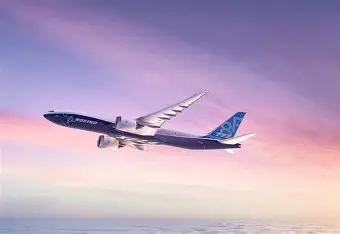
The Boeing 777X is the manufacturer’s attempt to modernize the aircraft’s winning formula for a new generation. The family includes the Boeing 777-8 and 777-9 passenger models, with the manufacturer listing two-class capacities of 395 seats for the 777-8 and an impressively higher 426 seats for the 777-9. Boeing gives the 777-8 as having a slightly longer range than the 777-9, which makes sense given its lighter load. Both aircraft use the large and capable General Electric GE9X engine, an advanced powerplant.
The program’s signature technological feature is a large composite wing with folding wingtips, designed primarily to improve overall aerodynamics in flight while preserving airport compatibility on the ground. Boeing markets the Boeing 777-9 as offering materially lower fuel burn and emissions than the aircraft it replaces, along with a quieter cabin and more modern interior architecture.
Strategically, the Boeing 777X has been seen as a successor to both the 747 and the legacy 777 in the aircraft manufacturer’s portfolio, sitting above the 787 in capacity in the company’s long-haul commercial portfolio. That is exactly why the aircraft matters so much, as it is supposed to be Boeing’s flagship widebody for the biggest long-range passenger missions. Nonetheless, that ambition has been undercut by delay after delay.
Credits: Boeing 777X