

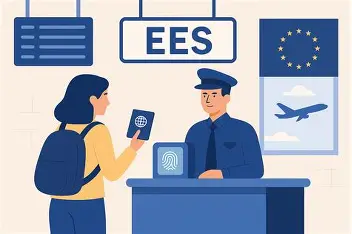
The new Entry/Exit System (EES) for European countries – including Greece – will be fully implemented from 10 April with airport and airline associations expressing concerns about delays, at a time when international travel is already experiencing intense turbulence due to the war in the Middle East.
The EES, which gradually began operating from 12 October 2025, is a new automated border control system introduced by the European Union to register third-country nationals (including holders of only an Australian passport) travelling to most European states for a short stay.
Advertisement
As the Greek embassy in Australia pointed out in a post on social media, the EES replaces the manual stamping of passports with digital and biometric data (such as fingerprints and facial images).S
- Who does it apply to:
All third-country nationals (whether or not a Schengen visa is required), entering for a short stay — up to 90 days within any 180-day period — in EU and Schengen Zone countries participating in the program.
- Participating countries:
The EES concerns Austria, Belgium, Bulgaria, Croatia, Czech Republic, Denmark, Estonia, Finland, France, Germany, Greece, Hungary, Iceland, Italy, Latvia, Liechtenstein, Lithuania, Luxembourg, Malta, Netherlands, Norway, Poland, Portugal, Romania, Slovakia, Slovenia, Spain, Sweden, Switzerland.
Upon entering these countries for short stays, you may need to:
- have your fingerprints and photo taken
- answer questions from the Schengen Borders Code (such as purpose of travel, length of stay, financial means, health insurance, etc.)
- The EES will create a digital file that records your biometric data.
- You do not need to take any action before reaching the border, the Authorities point out, while registration in the EES is free.
- Ireland and Cyprus will continue manual stamping for the time being.
Regarding the purpose and benefits of this change, the European Authorities state the following:
- Replacement of manual passport stamping.
- More accurate calculation of the permitted time of stay.
- Identification of those who exceed the permitted stay limit.
- Enhancing border security and combating identity fraud.
More specifically, all European Union Member States will register the data of third-country nationals (and holders of only an Australian passport) crossing the external borders for “short stays” (up to 90 days within 180 days). So with the EES, travel will become safer and smoother.
At border control points where electronic registration systems will be in place, third-country nationals will have their passport data, biometric data, facial image and fingerprints, and entry and exit data registered in the system.
The stamping of passports after the six-month political implementation that began in October 2025 is set to stop after 10 April 2026.
Therefore, the EES will be implemented and operated at all passport control points at the EU’s external borders and will be replaced by electronic registrations in the system.
The EES “will help border guards confirm that the person holding the passport is who they say they are and that their passport is real, not fake,” said Ashita Kanko, a member of the European Parliament who had served as the rapporteur on the EES.
WORRY ABOUT DELAYS
Europe’s airports and airlines have again expressed concerns about the impact the implementation of the EES will have on their operations, as the transition phase comes to an end just in time for the peak travel period of the Easter holidays.
Advertisement
Olivier Jankovec, Director General of the European Region of the Airports Council International, and Ourania Georgoutsakou, CEO of Airlines for Europe (A4E), in a joint statement noted:
“Passengers entering the Schengen Area are likely to wait even longer at border controls over Easter, due to ongoing operational challenges related to the implementation of the EES.”
Following the move to mandatory registration of 50% of third-country nationals on 10 March, the latest data collected from airports across Europe shows a continued deterioration in waiting times at border crossing points.
Waiting times now regularly reach up to two hours at peak times, with some airports reporting even longer queues.
This is despite the continued use by Border Control Authorities of both partial and full suspension of EES procedures at most airports during peak periods – measures that have proven essential to reduce waiting times and maintain operational continuity.
With the approach of the next critical milestones, airports and airlines are warning that the situation is at risk of deteriorating further.
“In this context, Europe’s airports and airlines are expressing serious concerns not only for the upcoming summer season, but already for the coming weeks. The combination of full registration requirements and reduced operational flexibility is expected to put unprecedented pressure on border control operations.”
Therefore, airports and airlines, among others, reiterate their call on the European Commission and Member States to urgently maintain the possibility of a full suspension of EES procedures, as a partial suspension alone will not be sufficient to avoid excessive delays.
They urge policymakers and administrations not to consider waiting times of one hour or more at the external Schengen borders as normal, which risk becoming systemic and undermining the passenger experience as well as the efficiency of the European air transport system.
Airports and airlines reiterate their full support for the objectives of the EES to strengthen border management and security. However, they stress that its implementation must be operationally feasible and must not be at the expense of passengers and the smooth operation of airports.
Advertisement
ETIAS
The new rules for the EES come into effect almost ten years after they were first proposed by the European Commission.
The next change in relation to travel to European countries – and Greece – is the operation of the European Travel Information and Authorization System (ETIAS), which, after a new postponement, is expected to come into force in the “last quarter of 2026”, according to the official EU website.
“No action is required from travellers at this time. The European Union will provide information on the exact start date of ETIAS several months before its implementation,” it notes.
ETIAS is an electronic system – similar to the American ESTA – that will complete the security check of visitors before they enter any country in the Schengen Zone.
AND THE WAR
Meanwhile, many fellow Greeks are preparing to travel to Greece for the summer, however, facing great difficulties and high costs, especially those who book last-minute tickets via alternative routes that avoid the Persian Gulf.
These flights have become… unscheduled, while those who already had reservations are trying to navigate the complicated environment created by the war in Iran, with cancellations, flight changes and security warnings.
The latest update from Smartraveller on this matter stated that military conflicts have caused widespread airspace closures, flight cancellations, and other travel disruptions, both in the Middle East region and around the world.
There are also difficulties in fuel supply worldwide, which have widespread impacts on travel.
Your plans may be affected, even if your destination is not in the Middle East.
New measures may be introduced in the near future.
The “Do Not Travel” recommendation also applies to transit and stopovers in affected areas. Even if you don’t plan to leave the airport, don’t travel through these countries, Smartraveller said.
If you travel to or transit through a country for which a “Do Not Travel” recommendation applies, you may not be able to leave. Your safety will be at risk.
For the Middle East, the Australian government’s “Do Not Travel” recommendation, until at least Thursday, was in effect for: Bahrain, Iran, Iraq, Israel, Kuwait, Lebanon, Palestine, Qatar, Syria, United Arab Emirates.
Credits: Europe