
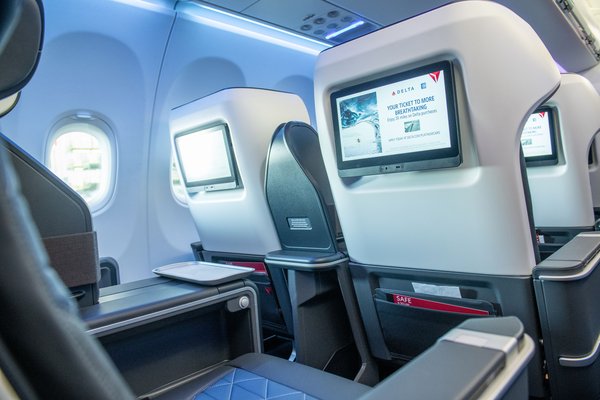
Delta Bluetooth headphones are moving beyond first class. The carrier is testing wireless pairing on more of its seatback screens. Until now the feature has been limited to first class on the Airbus A321neo fleet. The trial covers select aircraft, including some Boeing 767s, ahead of a wider rollout in 2026.
Delta Bluetooth headphones move past first class
Today, Delta Bluetooth headphones pairing works only in A321neo first-class cabins. There, passengers connect AirPods or other wireless sets straight to the seatback screen. Everyone else still uses the wired jack.
If the trials go well, Delta says the feature will reach more cabins and more aircraft types this year. That would move wireless pairing from a first-class perk toward a standard fitting.
Part of a larger seatback overhaul
The Bluetooth push is one piece of a much bigger in-flight entertainment refresh. Delta set out the plan at a January 2025 event in Las Vegas. It covers 4K HDR QLED seatback displays and a cloud-based platform with far more onboard content storage.
The new screens arrive on select aircraft in 2026. So do the incoming Airbus A350-1000s and the newest A321neos. All of it runs on a refreshed Delta Sync platform, which extends Bluetooth pairing through the whole cabin rather than just the front. Delta has also signed partnerships that bring ad-free YouTube and Crunchyroll libraries to the screens.
Why this took the industry so long
Pairing headphones to a seatback screen sounds trivial. It isn’t, and the reason says a lot about how aircraft cabins are built.
Every seatback screen belongs to a certified in-flight entertainment system. Adding a radio transmitter to several hundred seats is not a software update. It is new hardware in a pressurised cabin. Engineers must certify that it does not interfere with aircraft systems, then fit it seat by seat. Older IFE hardware often cannot host it at all. That is why the feature usually arrives with a new aircraft or a full cabin refresh.
Aviation also has a density problem all its own. Consumer audio was never designed for 200 active Bluetooth links in one metal tube. Pairing has to be reliable enough that you reach your screen, not the one two rows ahead.
Latency is the third constraint. Standard Bluetooth audio lags far enough to visibly desynchronise from video. For a system built around watching films, that is fatal. Low-latency codecs and the newer Bluetooth LE Audio standard fixed it. Their arrival in shipping hardware explains why this is happening now rather than five years ago.
An industry-wide shift
Delta is not alone. United Airlines has already fitted more than 100 aircraft with Bluetooth-enabled seatback screens, spanning its 787s, 737 MAXs and select Airbus jets. United says the feature will reach more than 800 aircraft by 2032.
JetBlue takes the opposite approach. It still relies on wired seatback connections across the fleet, so flyers there need a Bluetooth transmitter adapter. That split shows how unevenly the technology has spread among major U.S. carriers, even as wireless-only headphones become the norm.
What Delta Bluetooth headphones mean for flyers
Delta Bluetooth headphones remove the adapter and the spare wired pair from your bag. Two caveats are worth knowing.
First, availability follows the aircraft, not the airline. Fleet-wide fitting takes years, not months. The same route may use a fitted aircraft one day and an unfitted one the next, and your booking will not tell you which.
Second, battery life becomes your problem rather than the airline’s. That matters on a long-haul sector, where a wired pair simply worked. The safety rule has not changed either: headphones come off for taxi, takeoff and landing.
Why it matters for flyers
Delta carries roughly 200 million passengers a year. A change to standard cabin fittings therefore reaches a very large audience, even when it arrives one aircraft at a time.
Most travellers already default to wireless headphones. For them, this removes one of the last reasons to pack a wired pair or an adapter.
It also fits a wider pattern. Carriers have been upgrading their premium audio partnerships and treating headphone compatibility as a baseline expectation rather than a business-class extra.
Sources: The Points Guy — Delta trialing Bluetooth connectivity, AFAR — Delta unveils new high-tech screens, The Points Guy — United Airlines lets you connect AirPods to seatback TVs