
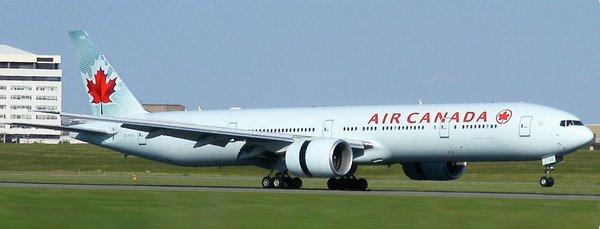
The Air Canada Heathrow emergency on May 2 sent a Boeing 777-300ER back to London about an hour into its flight to Toronto, after the crew transmitted the general emergency transponder code. No injuries were reported among the passengers or crew, and Air Canada has not confirmed what prompted the code.
Squawk 7700 over the Atlantic
Flight AC853, a 777-300ER registered C-FITL, departed Heathrow at 08:34 BST. The aircraft climbed to its initial cruising altitude of FL340 and was tracking west over the Atlantic when the crew transmitted a squawk 7700 emergency code at 09:30 BST, according to AirLive.
What squawk 7700 actually means
A transponder replies to radar with a four-digit code, and three of those codes are reserved worldwide. 7500 indicates unlawful interference, 7600 a radio communications failure, and 7700 a general emergency. Setting 7700 flags the aircraft on every controller’s display in range and buys the crew immediate priority — direct routing, protected airspace and emergency services on arrival.
The key point for reading a story like this one is that 7700 carries no information about severity or cause. It covers a technical malfunction, a medical event in the cabin, a pressurisation problem or a precautionary call by a crew who would rather have the airspace cleared than negotiate for it. A 7700 that ends in an uneventful landing with no injuries is a normal outcome, not a near-miss.
Why turn back rather than press on
Turning around mid-ocean rather than continuing to a North American alternate is standard practice for an unresolved fault. Once past the point where a return is straightforward, a North Atlantic crossing commits an aircraft to hours over water with a limited set of diversion fields — Keflavík, Shannon, Gander — none of which offers what a major hub does.
Heathrow, roughly an hour behind them, offered full emergency response for the Air Canada crew, the operator’s own engineering support and hotel and rebooking capacity for a full widebody load. Crews weigh landing weight in that decision too: an aircraft that has just tankered fuel for a transatlantic sector is well above its maximum landing weight, so a return usually means either holding to burn fuel down or accepting an overweight landing and the inspection that follows. Neither is an emergency in itself; both take time, which is part of why the aircraft was airborne for around 90 minutes on a flight that never left the region.
The Air Canada Heathrow return
The Air Canada Heathrow return ended on runway 27L at approximately 10:02 BST. Emergency vehicles met it at the gate. None of the occupants were injured.
Travel And Tour World reported that the cause of the emergency had not been disclosed by Air Canada at the time of publication. Yorkshire Live noted the aircraft was met at the gate by ground emergency response — standard procedure for any arrival squawking 7700, regardless of cause.
Who would investigate an Air Canada Heathrow diversion
Not every Air Canada Heathrow emergency becomes a formal investigation. The UK Air Accidents Investigation Branch has jurisdiction over occurrences in UK airspace, and Transport Canada has an interest as the regulator of the operator and the state of registry, but a reportable occurrence has to clear a threshold — serious injury, significant damage, or a safety issue with wider implications. A precautionary return that lands normally with no injuries frequently does not, and is handled through the operator’s own safety management system and routine occurrence reporting instead.
That is the most likely reason no findings have been published, and why none may be. Absence of an investigation report here is not evidence that something is being withheld.
The route and the type
The 777-300ER is the workhorse widebody for Air Canada’s transatlantic operations, and Heathrow–Toronto is one of the carrier’s highest-frequency routes on that side of the Atlantic, typically flown multiple times a day. That density matters operationally on Air Canada Heathrow services: a carrier with several daily rotations on a route can absorb one aircraft going technical far more easily than one flying it three times a week, which is why the disruption from an event like this is usually measured in hours rather than days.
AircrewNews will update this story if Air Canada or the UK Air Accidents Investigation Branch publish further information.