
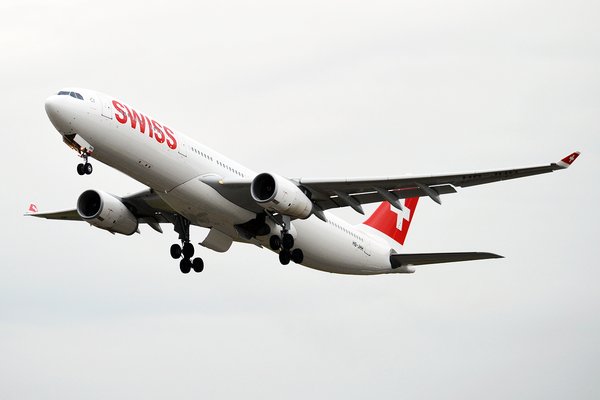
A SWISS A330 rejects takeoff at Indira Gandhi International Airport in Delhi on April 26 — the crew of SWISS International Air Lines flight LX147 aborting the roll after a No. 1 engine failure, with fire subsequently reported near the right main landing gear. Six minor injuries were reported during the precautionary evacuation and there were no fatalities. India’s Directorate General of Civil Aviation has opened an investigation.
Engine failure as the SWISS A330 rejects takeoff
When the SWISS A330 rejects takeoff, flight LX147 was bound for Zurich with 228 passengers, four infants and 13 crew. The aircraft, registered HB-JHK, accelerated to about 104 knots before the crew rejected the takeoff. The airline confirmed the timeline in a newsroom statement.
Smoke was visible on the left side, where the No. 1 engine had failed. Ground crews then reported a fire near the right main landing gear after the aircraft came to a stop on the runway.
Why 104 knots matters
Rejected takeoffs are categorised by speed, because the consequences scale with kinetic energy — and where a SWISS A330 rejects takeoff at 104 knots, that energy is considerable. Below roughly 80 knots an abort is a low-risk decision and crews will reject for relatively minor indications. Above that, the calculus tightens as the aircraft approaches V1 — the decision speed past which the takeoff must be continued, because there is no longer enough runway remaining to stop.
At about 104 knots on a widebody near its maximum takeoff weight for a long sector to Zurich, this was a high-speed reject. That means maximum braking, ground spoilers and thrust reverse, dumping the aircraft’s energy into the brakes as heat over a few seconds. Carbon brake stacks on a heavy A330 can reach several hundred degrees in a high-speed abort, and heat soaks into the wheel and tyre assembly for some minutes afterwards, which is precisely when a gear-area fire becomes a live risk. Wheels are fitted with fusible plugs designed to deflate a tyre in a controlled way rather than let it burst under that heat load.
Two events on opposite sides of the aircraft
The detail investigators will focus on is geometry. The engine that failed was the No. 1 — the left engine. The fire was reported near the right main landing gear. Those are opposite sides of the aircraft, which makes a simple mechanical chain between the two harder to draw.
Two broad possibilities present themselves, and the published information does not distinguish between them. Brake energy from the reject alone can produce a gear-area fire with no connection to the engine event beyond having caused the abort. Alternatively, a common factor or a sequence not yet public could link them. Establishing which is exactly the sort of question a formal investigation exists to answer, and it would be wrong to assume either from the outside.
Evacuation and aftermath
The crew commanded an emergency evacuation via the slides. SWISS confirmed six minor injuries; no serious injuries were reported. Emergency services secured the area before the aircraft was removed from the runway for technical inspection.
A rejected takeoff also stops the aircraft on the runway rather than clearing it, which at a hub of Delhi’s size has immediate knock-on effects. A disabled widebody has to be inspected, its brakes allowed to cool and its tyres checked before it can be towed, and until then the runway is out of service — pushing arrivals into holding and departures into ground delay across the evening bank.
Minor injuries in a slide evacuation are common rather than exceptional. An A330 slide deploys at a steep angle from a door sill several metres above the ground, and an evacuation of more than 240 people down them at speed reliably produces sprains, abrasions and the occasional fracture. Six minor injuries across that number of occupants is, in evacuation terms, an orderly outcome.
What investigators watch after a SWISS A330 rejects takeoff
Simple Flying and The Aviation Herald reported the incident on the carrier’s evening Zurich rotation. Both noted that the No. 1 engine failure and the gear-area fire — on opposite sides of the aircraft — would be central questions for investigators.
Jurisdiction follows ICAO Annex 13: India is the state of occurrence and the DGCA leads, while Switzerland as the state of the operator and of registry is entitled to appoint an accredited representative, as are the states of design and manufacture for the airframe and engines.
SWISS said the A330 has been removed from service pending the DGCA investigation. The carrier has not commented on a likely return-to-service date or on the relationship between the engine failure and the fire. AircrewNews will update this story as official findings are released.